


Missed the earlier episodes? Episode 1: The Jedburgh Teams | Episode 2: Commander, #2, radio operator
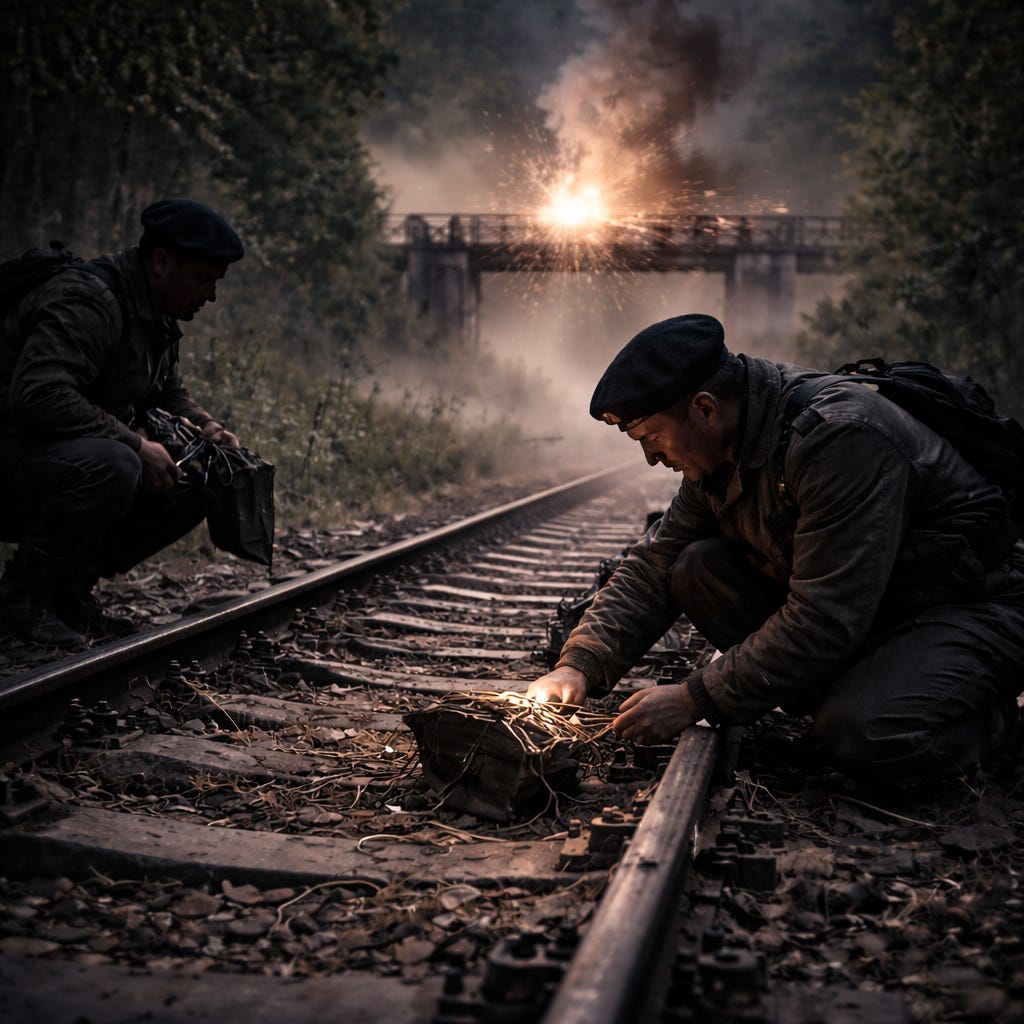
In the summer of 1944, a young Scottish officer crouched in the darkness near Figeac in south-central France, watching the column of German armor stretch to the horizon. Fifteen thousand men. Two hundred tanks and half-tracks. The full might of the 2nd SS Panzer Division Das Reich, moving north to crush the fragile Allied beachhead at Normandy.
His name was Tommy Macpherson. He was 23 years old, wearing a tartan kilt, and commanding a resistance force of roughly two dozen farmers with rifles.
He decided to attack.
What Jedburghs Actually Did
Last week we left our three-man teams at the moment their boots hit French soil—uniformed soldiers in enemy territory, criminal under German law, with sixty pounds of weapons and radios and no backup within a hundred miles.
Now we talk about what they did next.
The official mission was simple: link up with the Maquis, train them, arm them, coordinate their activities with Allied command. The reality was improvised chaos conducted at speed, usually under fire, always with inadequate resources.
The Jedburghs had three primary tools: sabotage, ambush, and radio. The first two created immediate disruption. The third turned scattered attacks into coordinated strategy.
A Jedburgh team would identify a target—a railway bridge, a power pylon, a telephone relay station—calculate the explosive charge, and blow it. Then move. Then do it again. Then radio London with the results, receive new intelligence and orders, and sleep a few hours before starting over.
The BBC would broadcast coded messages confirming the missions — cryptic phrases that meant nothing to a German listening post and everything to a Maquis leader crouched over a radio in a farmhouse cellar.
At peak operations in July 1944, Jedburgh teams were conducting dozens of simultaneous sabotage operations across France. The Wehrmacht was bleeding not from a single wound but from a thousand cuts.
Team Quinine: The Kilted Killer
Tommy Macpherson had already escaped German captivity twice by the time he was assigned to Jedburgh Team Quinine. The first escape was from an Italian POW camp after being captured trying to assassinate Erwin Rommel. The second involved walking hundreds of miles through occupied Europe to reach Sweden. He’d been home from that adventure for exactly three weeks when SOE knocked on his door.
By January 1944 he was at Milton Hall, training. By March he was promoted to Major. His team: French Lieutenant Michel de Bourbon—nephew to the pretender to the French throne—and British radio operator Sergeant Arthur Brown, both twenty years old.
On the night of June 8, 1944—48 hours after D-Day—a Halifax bomber dropped them into the Massif Central from 7,000 feet.
Under his jump smock, Macpherson wore full Cameron Highlander battle dress. Kilt included.
”Just as I arrived,” he recalled later,” I heard an excited young Frenchman saying to his boss, ‘Chef, chef, there’s a French officer and he’s brought his wife!’”
The Maquis had never seen a man in a skirt before.
Macpherson’s logic was deliberate. “As a British officer parachuted into a resistance situation,” he explained, “your only authority was your own personality, which I had tried to reinforce with my kilt and a degree of flamboyance.” He needed the Maquis to believe he was someone worth following. The kilt announced: I am different. I am confident. Follow me.
It worked. Within 24 hours he had them blowing up railway bridges.
The Das Reich Problem
On June 10—two days after landing—Macpherson received intelligence that changed everything.
The 2nd SS Panzer Division Das Reich was moving north.
Das Reich was one of the most feared formations in the German military. It had spent two years on the Eastern Front, where it had learned to treat civilian resistance as a problem to be solved with mass murder. Now it was driving north from Toulouse toward Normandy, and whoever was in its path—Allied soldier or French farmer—was going to suffer.
The Allies desperately needed time. The Normandy beachhead was still fragile. Every hour Das Reich spent in southern France was an hour the invasion force used to reinforce, resupply, and dig in.
That was Tommy Macpherson’s problem now.
He had perhaps 30 Maquis fighters—most of them untrained, some of them armed with weapons that dated to the First World War. Das Reich had 15,000 men and 200 armored vehicles. Direct engagement would be suicide. He had already seen other Resistance groups try frontal attacks on the column: the results were brief, bloody, and pointless. The Germans barely slowed down.
Macpherson chose a different approach.
Through the night, he and his men worked the road ahead of the column along the Figeac-Tulle road: mines buried in the tarmac, grenades hung from tree branches on hair triggers, the surrounding trees felled just enough that they’d come down at the right moment. It was not a battlefield. It was a trap.
At the first ambush, a tank hit the mine and slewed across the road. The column stopped. German engineers moved up to clear the blockage. That’s when Macpherson’s men opened fire, then melted into the forest before the armored response arrived.
They repeated this every few miles, all the way north. Hit, withdraw, reposition, hit again. Never stand and fight. Never give the Germans a target they could destroy. Because stopping wasn’t an option. Every hour Das Reich spent clearing another roadblock was an hour the beachhead survived.
By the time Das Reich reached Normandy, it was 17 days behind schedule.
Military historians have argued about what those 17 days were worth. The conservative view is that it cost the Germans a critical window when the Allied defenses were still being established. The aggressive view is that it may have saved the entire invasion. Either way, Macpherson and a handful of farmers with old rifles bought that time.
The Great Bluff
But Macpherson wasn’t finished.
Three months later, in September 1944, he was still operating in France when intelligence reached him through another Jedburgh commander: a German general named Botho Henning Elster was moving a column of 23,000 troops north—the remnants of the forces that had occupied southern France, now trying to reach the German lines before they were cut off. Elster had already tried to negotiate surrender with the Americans, but the Americans suspected he was stalling.
Would Macpherson try?
He drove toward the German column in a captured Red Cross vehicle—unarmed, with a German doctor and a French officer—through miles of German-held territory and occasional machine gun fire. When he reached the schoolhouse where Elster was waiting, Macpherson walked in wearing full Highland uniform, bonnet included, and told the general he had twenty minutes to decide.
Surrender now, he said, or face the full weight of artillery and RAF bombing.
In reality, Macpherson had almost nothing. A few French irregulars who would have been slaughtered by any organized German response.
Elster surrendered.
Twenty-three thousand German soldiers laid down their arms to a young man in a kilt who hadn’t yet reached his 24th birthday.
When the Allied press corps arrived to cover the surrender, Macpherson—following standing orders—said nothing and let the American lieutenant who was present take credit. Most histories attribute the surrender entirely to US forces. It took decades for the real story to emerge.
The Pattern
Macpherson’s story is extraordinary but not unique. Across France in the summer of 1944, Jedburgh teams were operating the same template: small teams, improvised tactics, enormous results.
Team Frederick coordinated resistance operations that destroyed fuel depots the Wehrmacht desperately needed for its Panzers. Team Chloroform shut down rail lines in Brittany so thoroughly that German troops couldn’t be repositioned before Patton’s breakthrough. Team Hamish organized the Auvergne Maquis into a force capable of holding its own territory, tying down German units that should have been at Normandy.
In the 90 days between D-Day and the Liberation of Paris, Jedburgh teams participated in operations that:
Destroyed 164 rail lines, forcing the Germans to use road transport that was slower, more fuel-intensive, and more vulnerable to Allied air attack. Conducted or coordinated 1,820 vehicle ambushes. Cut telephone and telegraph lines over 1,000 times. Armed and organized resistance forces totaling over 130,000 fighters—a force larger than many national armies.
And they did it with three men, a radio, and whatever the local Maquis could provide.
The Price
It is tempting to make this entirely heroic. It wasn’t.
The Jedburgh missions produced some of the most remarkable individual achievements of the war. They also produced atrocities that neither side has fully reckoned with.
Das Reich’s rage at being harassed and delayed expressed itself at Oradour-sur-Glane on June 10, 1944, where SS troops locked 642 men, women, and children in a church and burned it. The village was erased from the map. It remains a ruin today, preserved exactly as Das Reich left it—a French war memorial and a reminder of what guerrilla warfare costs the people caught between two armies.
The Jedburgh teams knew this was possible. They had been trained to accept it as the price of strategic delay. Whether that calculation was correct is a moral question that has never been definitively answered.
What is certain: the men who made it—Tommy Macpherson, Team Quinine, and the 93 other Jedburgh teams—have largely been forgotten. Their medals are in display cases. Their names appear occasionally in footnotes. The operations that shaped the Liberation of France remain officially secret for fifty years.
Why It Matters
Macpherson died in 2014, at 94, as Britain’s most decorated surviving veteran. Three Military Crosses, three Croix de Guerre, a Légion d’honneur, a papal knighthood. When asked whether he considered himself a hero, he said simply that he had been doing his job.
“Just doing my job” is what modest men say when they’ve done something they can’t fully explain. The kilt was flamboyance. The midnight road-minding was craft. The bluff with Elster was audacity. But underneath all of it was something harder to name: the willingness to stand in the dark next to a road where 15,000 SS soldiers were sleeping, and decide that this was a fight worth having with whatever you had.
Three men and a radio. That was the Jedburgh template.
Next week: The reckoning. How Jedburgh operations ended, what happened to the survivors, and why the program shaped every special operations doctrine that followed.
A word from the sponsor
Secret Heroes is brought to you by the Eddie Grant Saga, my Paris thriller series featuring Eddie Grant, a wealthy former Special Forces commander living in Paris who takes on secret missions for the CIA as a volunteer and for no pay.
The world Macpherson and the Jedburgh teams operated in—clandestine operations, Resistance networks, the moral weight of wartime choices—is the same world Eddie navigates, just 75 years later. Start reading with Treasure of Saint-Lazare, which was chosen top historical mystery in its year by Readers’ Favorites.
Further reading about the Jedburghs:
- Behind Enemy Lines by Tommy Macpherson and Richard Bath — his memoir, published when he was 91
- Das Reich: The March of the 2nd SS Panzer Division Through France by Max Hastings
- Operation Jedburgh: D-Day and America’s First Shadow War by Colin Beavan
This really is great stuff and should be fleshed out into a book. Congratulations, John, and keep going!