


They dropped from bombers flying so low their dark parachutes opened almost instantly, briefly catching the moonlight before a quick, hard landing in the fields, hedgerows, and forest clearings of occupied Europe.
Three men.
Three different accents.
One radio.
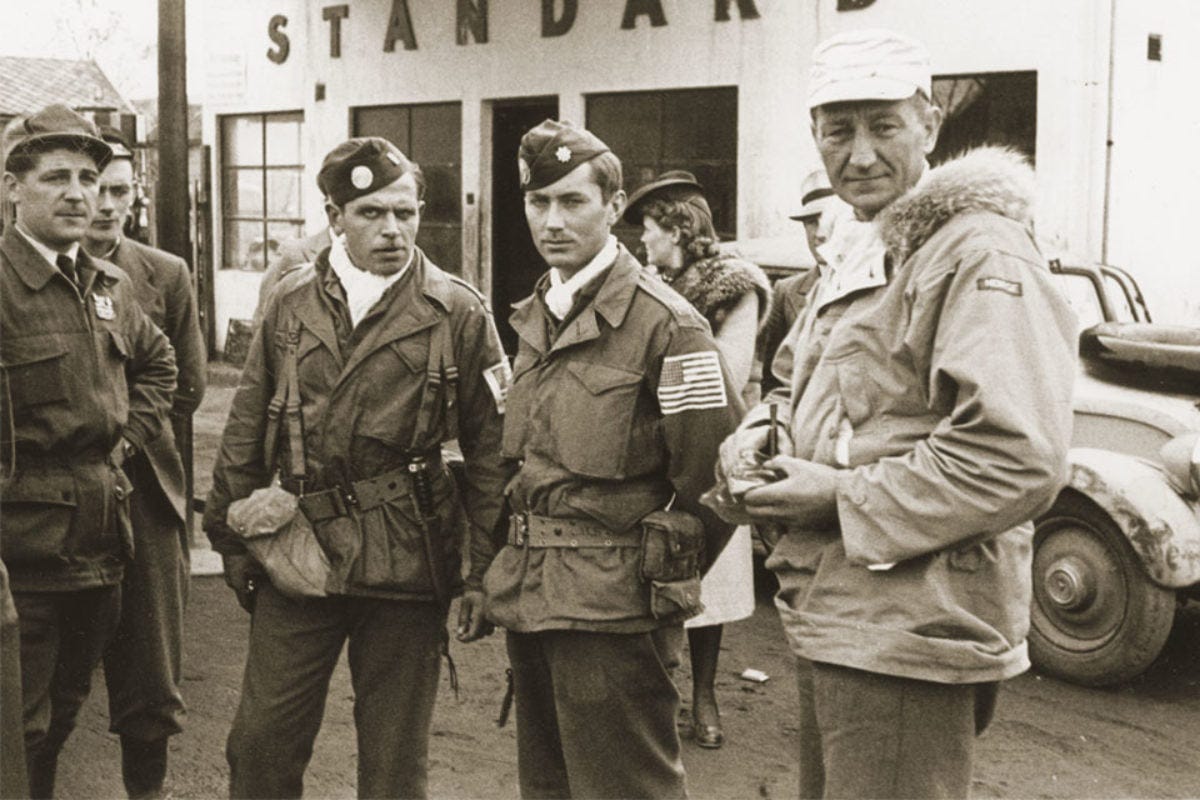
Unlike many clandestine agents before them, they did not discard their identity entirely. Each man wore a uniform—British battledress, American field gear, or Free French insignia—chosen deliberately and worn with intent. If captured, they were determined not to vanish into the legal void reserved for spies and saboteurs. They were soldiers, operating behind enemy lines, and they wanted that fact to be unmistakable.
They were called Jedburghs, and their war would be fought in places where uniforms offered only limited protection.
Dropped Into the Dark
In the spring of 1944, as Allied armies assembled in southern England and the largest amphibious invasion in history took shape, another war was already being waged across occupied Europe.
In France, Belgium, and the Netherlands, Resistance networks had survived years of brutal counterintelligence pressure. Some were strong, others badly compromised. Many had courage in abundance but lacked weapons, coordination, and reliable contact with Allied planners. The German security services, meanwhile, had become highly effective at infiltrating and dismantling clandestine organizations, often by tracing radio transmissions or turning captured agents.
The success of the coming invasion would depend in part on these underground networks—on their ability to sabotage rail lines, delay German reinforcements, gather intelligence, and create confusion far from the beaches of Normandy.
What they needed was not leadership imposed from outside, but connection.
Why the Jedburghs Existed
By late 1943, both Britain’s Special Operations Executive and America’s Office of Strategic Services understood that individual agents, however skilled, were no longer enough. The scale of what was coming demanded a new approach: something more durable than a single courier, more flexible than a formal military unit.
The solution was the Jedburgh team.
These were small, multinational groups—usually three men—trained together, dropped together, and embedded directly with local Resistance forces. They would not command operations in a conventional sense. Instead, they would coordinate, advise, supply, and communicate, acting as living links between clandestine fighters in occupied territory and Allied headquarters in London.
The project itself was an experiment in cooperation, bringing together British, American, and Free French personnel in a way that would have been unthinkable earlier in the war. Differences in doctrine, culture, and temperament were accepted as the price of effectiveness.
Soldiers, Not Spies
The decision for Jedburghs to wear uniforms was neither symbolic nor cosmetic. It was legal, moral, and practical.
Earlier agents operating under civilian cover—like the women already featured in Secret Heroes, plus the men and women to follow—had accepted the reality that capture often meant execution. The Jedburghs were different. They were trained as soldiers and inserted as soldiers, even though their missions placed them far behind enemy lines and deep within civilian populations.
Uniforms offered no guarantee of safety. German forces did not always respect distinctions between combatant and spy, especially in the bitter struggle against Resistance movements. But the uniform mattered all the same. It reflected how the Allies saw these men: not as expendable assets, but as part of the armed forces, operating under orders and prepared to accept the risks that came with that status.
The Three-Man Team
Each Jedburgh team was deliberately small, designed for mobility and trust rather than firepower.
Typically, a team consisted of a commander—American or British—responsible for liaison with Allied command; an executive officer, often Free French, whose language skills and cultural fluency were essential; and a radio operator, whose ability to transmit accurately and sparingly could determine the survival of everyone around him.
The radio operator remained the most vulnerable member of the team. German direction-finding units roamed the countryside, and prolonged transmissions could be detected with alarming speed. A single careless signal could unravel not just the team, but entire Resistance networks that depended on them.
Training reflected these realities: parachuting, demolitions, weapons handling, radio discipline, and the less tangible skills of judgment, restraint, and patience. Jedburghs were taught not only how to fight, but when not to.
Living With the Resistance
Once on the ground, Jedburghs did not arrive as commanders issuing orders. They lived with the Resistance—sharing food, shelter, fear, and long periods of waiting.
They helped organize supply drops, trained fighters in sabotage and weapons use, coordinated timing with Allied plans, and transmitted intelligence back to London. Just as often, they acted as intermediaries, navigating tensions between rival Resistance groups and aligning local priorities with strategic necessity.
They learned quickly that authority meant little without trust, and that trust could not be forced. A successful mission depended as much on understanding village politics and personal loyalties as it did on explosives or radios.
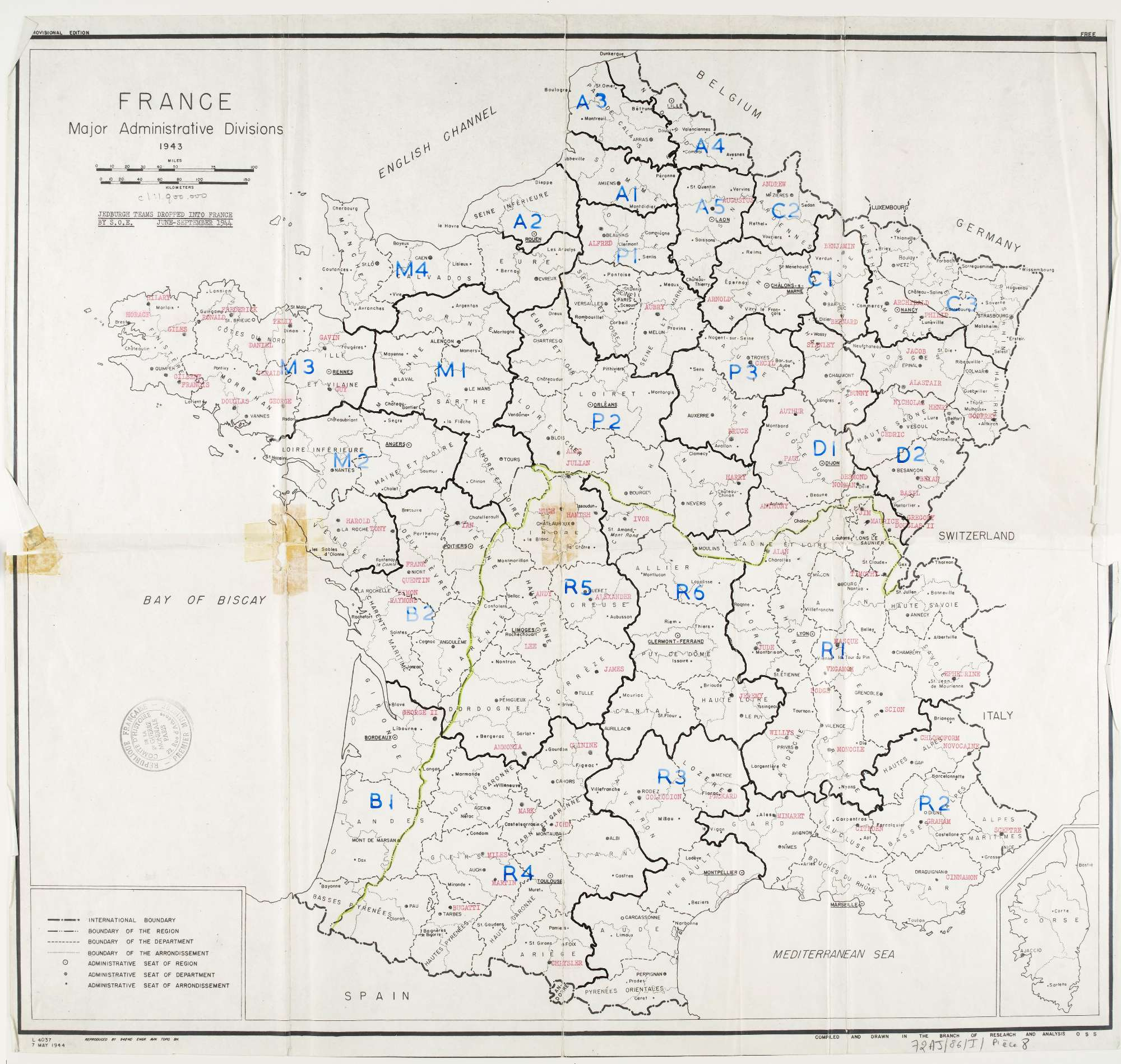
Jedburgh zones in occupied France, 1944
Waiting for the Signal
By early June 1944, Jedburgh teams were in place across much of occupied France, already integrated into Resistance networks.
They knew the invasion was imminent. They did not know the date.
Until then, they waited—monitoring radios, moving cautiously, and preparing for the moment when silence would give way to action. When that moment came, their work would help determine whether German reinforcements arrived on time, or not at all.
Their role was never meant to be visible. If they succeeded, the credit would flow elsewhere. If they failed, the record might never reflect what had been lost.
Next week: What happened when the invasion finally began—and what it meant to be captured while wearing a uniform in a war that often ignored such distinctions.
For Further Information…
“Before Special Forces and CIA paramilitaries, there were the WWII Jedburghs.” Multi-national teams parachuted in to blow up bridges and generally confound the Germans, mainly after Normandy. From Spyscape.
Operation Jedburgh, which brought together agents from the SOE (Britain), OSS (American), and French intelligence agency, dropped groups of agents into the occupied countries in support of the Normandy invasion. From Wikipedia.
“Surprise, Kill, Vanish: The Legend of the Jedburghs” CIA Stories.
Jedburghs and the French Resistance test the Nazi hold on France. Daily Chronicles of World War II.
Unknown Heroes: Behind Enemy Lines at D-Day. Youtube.
Alchetron, free social encyclopedia
Brought to you by …
TREASURE OF SAINT-LAZARE, a novel by John Pearce. “A man caught in the middle of a search for World War II war treasures and a murder plot finds himself re-examining his own past tragedies” (Kirkus)
Best historical mystery of its year (Readers’ Favorite)
Why were they named Jedburgh?
We need some of those in America, don't you think? Ahead of the midterms.
Good stuff. I'm enjoying it.
BTW my Italian uncle's wife was a White Russian refugee in France who fought with the Resistance to prepare for the Normandy landings. The Nazis tracked down her cell and she was shot in the head and thrown off a cliff and left for dead. But she was tough and survived and though partially paralyzed lived to be quite old. I saw her in the 1960s and '70s. A formidable lady, believe me.