


Last week, we introduced the Jedburghs—the three-man Allied commando teams dropped behind German lines to arm and organize the French Resistance before D-Day. This week: how they were selected, trained, and equipped for missions most wouldn't survive. If you missed the first installment Operation Jedburgh, start here. These weren’t just commandos—they were hand-picked volunteers for what Churchill called “an undertaking of unusual hazard.”
The official story said Jedburghs were just liaison teams. Small groups sent to coordinate with the French Resistance before D-Day.
That was the cover story.
The truth? They were three-man wrecking crews designed to turn occupied France into hell for the Wehrmacht. And Winston Churchill himself ordered their existence classified. The ban wasn't lifted for almost half a century.
Why the Secrecy?
The Jedburghs violated every rule of conventional warfare. They operated behind enemy lines without formal military support. They armed civilian resistance fighters—a direct violation of the Geneva Conventions. They coordinated acts that, if discovered, would have justified Nazi reprisals against French civilians.
But unlike SOE agents who worked under civilian cover, Jedburghs deliberately wore military uniforms. This wasn’t symbolic—it was strategic. The uniform was supposed to protect them under the Geneva Conventions if they were captured. In practice, Hitler’s Commando Order meant, uniformed or not, capture often meant execution. But the Allies insisted on uniforms anyway, treating these men as soldiers, not expendable spies.
Churchill knew what history would say about arming civilians and coordinating guerrilla warfare. So he buried it.
The Selection Process
You couldn’t simply volunteer for Jedburgh. They came for you.
British MI6, American OSS, and French BCRA intelligence agencies compiled lists of candidates. The criteria were specific and brutal:
- Fluent French (not just conversational—fluent enough to pass as a native under interrogation)
- Combat experience (proven under fire, preferably in unconventional warfare)
- Parachute qualified (or willing to become so immediately)
- Psychological stability (they needed men who could kill a sentry silently, then have breakfast with villagers)
- Ability to operate independently (no reinforcements, no extraction, no second chances)
The washout rate during training approached 40%. Not because men couldn’t handle the physical demands—because they couldn’t handle the moral ones.
The Training
Milton Hall, a requisitioned estate in Cambridgeshire, became Jedburgh headquarters. From January to June 1944, nearly 300 men trained there for missions most wouldn’t survive.
The curriculum:
Weapons: Every firearm the Allies or Axis used, plus improvised weapons. Jedburghs had to maintain, repair, and teach others to use:
- Sten guns (notoriously unreliable)
- German MP40s (captured weapons were common)
- American M1 carbines
- British Lee-Enfield rifles
- Plastic explosives (C2, the predecessor to C4)
- Gammon grenades
- Mortars, machine guns, bazookas
Sabotage: Railway destruction, bridge demolition, communications disruption, vehicle ambushes. They learned to calculate explosive charges by eyeballing a target. Too little, and the bridge still stood. Too much, and you wasted supplies you couldn’t replace.
Silent killing: Knives, garrotes, bare hands. They practiced on dummies, then live animals, then—according to some accounts—condemned prisoners of war. (This is disputed and is obviously something that would be kept highly secret, but it's worth remembering that this war was the defining existential experience of the 20th Century.)
Tradecraft: Dead drops, codes, safe house protocols, interrogation resistance. They memorized cover stories in such detail they could recite them under torture.
Leadership: How to organize civilians who’d never fired a weapon into effective guerrilla units. How to inspire farmers to blow up trains. How to discipline a resistance fighter without destroying morale.
The Three-Man Team Structure
Every Jedburgh team had three roles:
The Commander: Usually British or American. Made tactical decisions, coordinated with Allied command via radio, and took responsibility when things went sideways.
The Executive Officer: The second-in-command. Often from a different nation than the commander (deliberate cross-training). Took over if the commander was killed or captured.
The Radio Operator: Usually French. The only team member guaranteed to speak native-level French. Handled all communications with London, maintained the radio equipment, and often served as primary liaison with local resistance leaders.
This structure was brilliant. If one man was captured, the other two could continue. If two were killed, the survivor could still complete the mission or at least report intelligence.
Teams deployed with:
- Uniforms: British teams wore the camouflaged Denison smock (the same distinctive jump smock worn by British Airborne) with a black Royal Armoured Corps beret instead of the airborne maroon. American teams wore standard U.S. paratrooper uniforms. All wore the special “SF” (Special Force) wing insignia on the right shoulder.
- Three radios (one main, two backups)
- Enough weapons to arm a dozen resistance fighters
- Gold coins (universally accepted currency)
- Suicide pills (cyanide capsules, though most threw them away)
- Silk maps (hidden in clothing)
- Escape compasses (disguised as buttons)
- Forged identity papers
- Civilian clothes (for backup)
Weight per man: 60-80 pounds, not counting the parachute.
The Jump
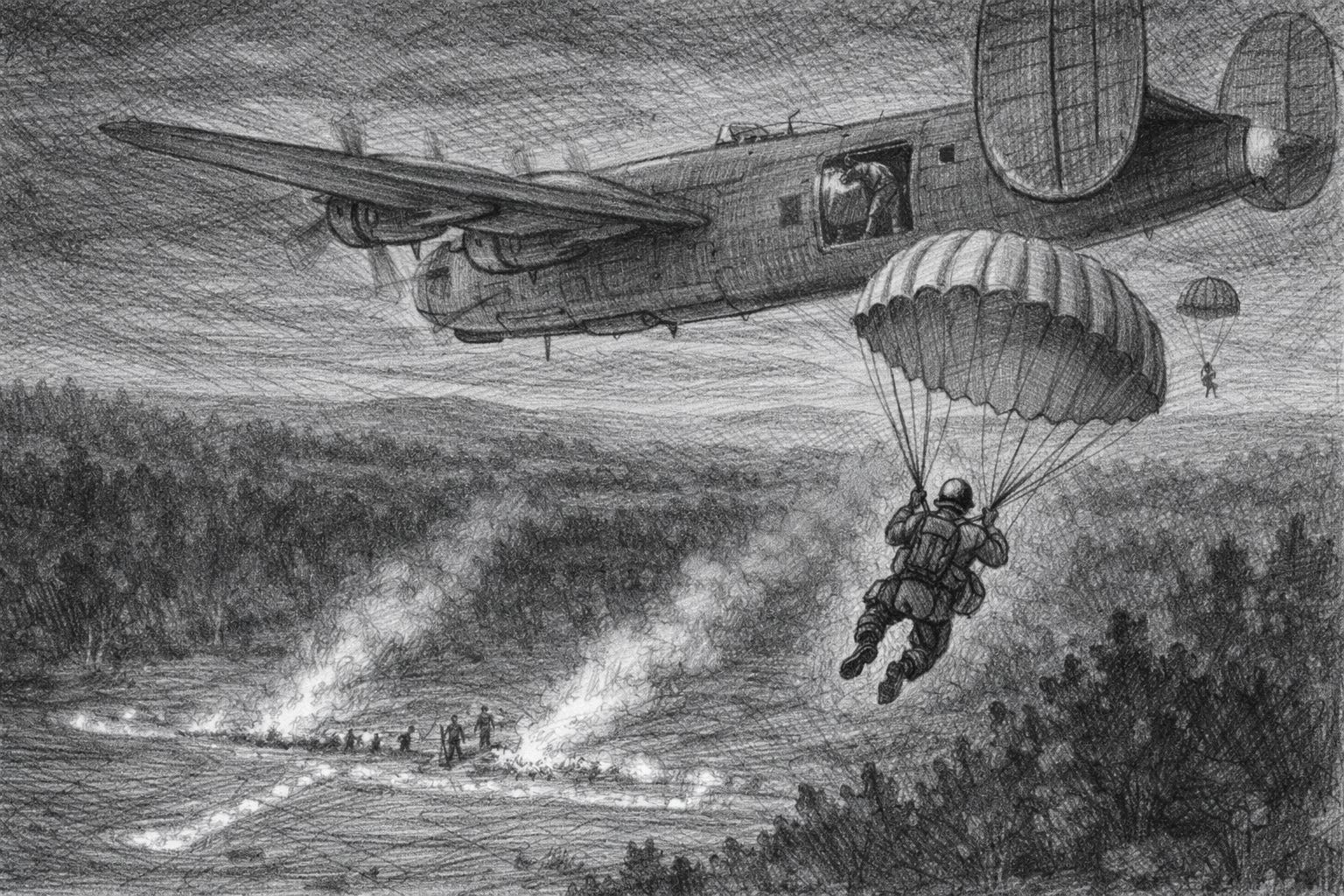
Jedburghs deployed at night from modified B-24 Liberators. The aircraft flew low—500 to 800 feet—to avoid German radar. At that altitude, parachutes barely had time to open. They were a special design, made of dark fabric. There was no reserve chute.
The BBC broadcast coded messages to alert resistance groups: ”The tomatoes are ripe” or ”The moon is full.” Maquis fighters would light signal fires in predetermined patterns, visible only from directly overhead.
Then three men jumped into darkness, carrying enough equipment to start a war.
Most teams landed in German-occupied territory with no friendly forces within a hundred miles. The moment their boots hit French soil, they were criminals subject to execution.
Behind the Lines as the Front Advanced
As Allied armies pushed inland from Normandy, Jedburgh teams found themselves in an unusual position. They had begun the summer isolated behind enemy lines; by late August, advancing Allied forces were overtaking regions where they had been operating for months.
Some teams emerged from forests and safe houses to greet regular troops in uniform—no longer theoretical soldiers behind the lines, but recognized members of the Allied war effort. Others continued to operate in regions where German units were retreating chaotically, creating unpredictable and dangerous conditions.
In certain cases, Jedburghs helped smooth the transition from underground resistance to provisional local authority. They could vouch for Resistance leaders to arriving Allied commanders and help prevent unnecessary clashes or confusion.
Their multinational structure—American, British, Free French—proved especially valuable in these moments. They were not outsiders parachuting in at the last minute; they were already known quantities to the fighters on the ground.
The Jedburgh operations remained classified for nearly four decades after the war, with information beginning to be declassified only in the 1980s along with other OSS records.
---
Next week: The missions themselves. What Jedburghs actually did in the 90 days between their deployment and the Liberation of Paris.
Why This Matters
The Jedburgh program created the template for modern special operations. The Green Berets, Delta Force, Navy SEALs, British SAS—they all trace their lineage back to Milton Hall.
Small teams. Deep behind enemy lines. Training local forces. Fighting asymmetrically.
Sound familiar? It should. We’re still doing it today.
Secret Heroes is brought to you by my Paris thriller series, where some of these tactics show up in unexpected ways. If you enjoy this kind of storytelling—where historical truth gets mixed with modern suspense—start with Treasure of Saint-Lazare. Or see the entire Eddie Grant series here.
And if the Jedburgh story resonates with you, you'll want to watch for my forthcoming novel about Artie Grant—a man who didn't parachute into occupied Paris because he was already there when the Germans arrived, building networks that would last four years of occupation.
---
Further reading:
- The Jedburghs: The Secret History of the Allied Special Forces, France 1944 by Will Irwin
- CIA: Surprise, Kill, Vanish - The Legend of the Jedburghs
- History of the Jedburghs in Normandy - D-Day Overlord
- Review of Eisenhower's Guerrillas: The Jedburghs, the Maquis, & The Liberation of France, by Benjamin F. Jones, 2016
John, collect these pieces about WW Two into a short book! Good stuff.