


This Day in WWII | Monday, June 9, 1941 | Part-Time Parisian
On a Monday morning in the summer of 1941, someone in London sat down with a map of France and a problem no one had ever solved before: how do you put an army on a beach that an enemy is already defending?
He didn’t have a title yet. He didn’t have a commander. He had almost none of the ships he would need. What he had — all he had — was the problem itself.
That man was Lt. General Frederick Morgan. The plan he was beginning to sketch, three years before its execution, would become Operation Overlord. The date he had in mind, though no one knew it yet, was something close to June 6, 1944. The beaches he was studying were in Normandy. And the people who needed this plan most — the ones living under occupation in Paris, just across the Channel — had no idea any of it was happening.
The idea before the plan
The concept of a cross-channel invasion had existed in British military thinking almost from the moment the last boats cleared Dunkirk in June 1940. Even before the United States entered the war, British planning staffs had been preparing preliminary studies of what it would take to land armies back on the Continent. The problem was almost too large to hold in one mind. An operation of this kind would require elements that had never existed — in quantities that had never been assembled — executing a kind of assault that had never been successfully carried out on this scale.
At the Arcadia Conference in Washington in late December 1941, the American and British Chiefs of Staff developed, and Roosevelt and Churchill approved, a broad strategic plan for the war. One of its foundations was the eventual necessity of a cross-channel invasion. But “eventual” covered a lot of ground. In the summer of 1941, with America not yet in the fight, Barbarossa just launched in the East, and the Wehrmacht occupying most of Western Europe, “eventual” felt very far away.
The man with no commander
As a result of the Casablanca Conference in January 1943, the western Allies affirmed their commitment to an invasion of the Continent in 1944 and directed the creation of a planning staff. Since the future invasion commander had not yet been selected, the staff would be headed by the Chief of Staff to the Supreme Allied Commander (designate) — the acronym COSSAC. Morgan was chosen for the job.
It is worth pausing on the peculiarity of this arrangement. Morgan was placed at the head of a combined British-American planning team — appointed Chief of Staff to a Supreme Allied Commander who had not yet been named. He was, in effect, building the headquarters for a general who didn’t exist yet, planning the largest invasion in history for a command that was still theoretical. The British Chiefs of Staff gave him until July 15, 1943, to produce three interrelated plans: a deception plan, a contingency plan in the event of German collapse, and the main invasion plan itself.
Morgan got to work.
The postcard solution
One of the first and most pressing questions was where. The French coastline runs for hundreds of miles. Not all of it was equally defended, equally accessible, or equally survivable.
In 1942, the BBC had appealed to the British public to send in any snapshots or postcards of coastal Europe — from Norway to the Pyrenees. Millions arrived at the War Office. Morgan’s team sifted through them to measure seawall heights, assess beach gradients, and determine which sands might be firm enough to support thousands of troops and vehicles.
The liberation of France was planned, in part, from strangers’ holiday photographs.
Those postcards led to early conclusions about which stretches of Normandy were viable. Morgan’s original plan called for landings on three beaches — it was later expanded to five at Montgomery’s insistence. The difference was not merely logistical. More beaches meant more dispersed German resistance, faster breakout, and ultimately fewer casualties. Montgomery’s push mattered enormously.
The harbor problem
Even finding the right beaches wasn’t enough. An invading army requires continuous supply. Without a port, how do you land 850,000 troops and hundreds of thousands of tons of equipment?
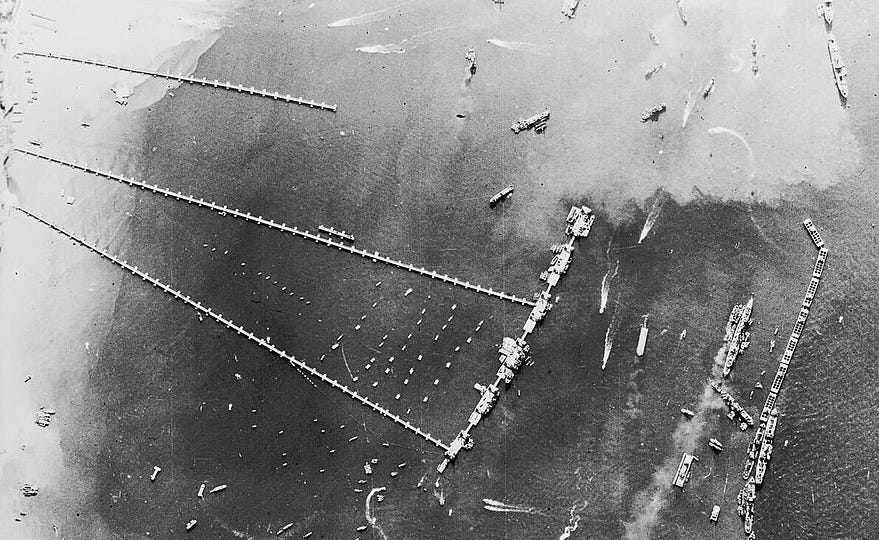
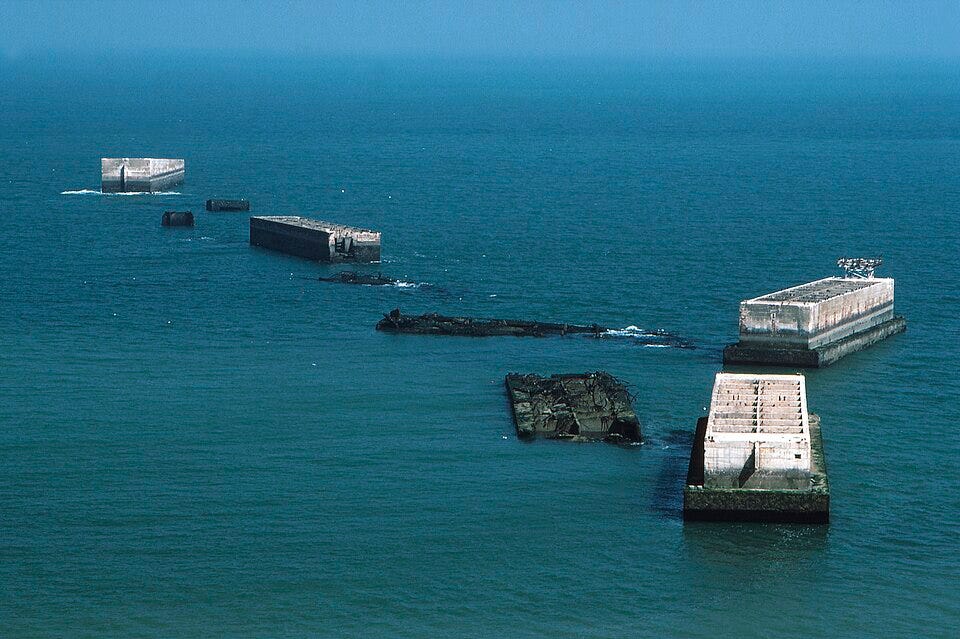
Morgan and his team developed plans for two prefabricated harbors — code-named Mulberries — consisting of enormous concrete and steel caissons that would be towed across the English Channel and assembled directly on the Normandy coast. Nothing like them had ever been built. They were engineering projects conceived on a military timeline, improvised answers to a logistical problem that had no precedent.
By the end of June 1944, the Allies had landed over 850,000 troops, 570,000 tons of supplies, and nearly 150,000 vehicles across the beaches of Normandy. The Mulberries made much of that possible.
This day across the years
June 4–9, 1942: The Battle of Midway was winding down in decisive American victory. The Pacific and Atlantic wars were running in parallel, each drawing from the same pool of ships, men, and industrial capacity that planners on both sides were counting on. Every landing craft built for the Pacific was one fewer available for Normandy.
June 6, 1944 — three years almost to the day: Nearly 160,000 Allied troops landed in Normandy. The armada numbered over 7,000 naval vessels. Nearly 2,400 Americans were killed or went missing on Omaha Beach alone. The plan that began with a map, a problem, and a box of strangers’ postcards ended there — in the water, on the sand, on the bluffs above. But it was the first step on the road to Berlin.
June 9, 1985: Near São Paulo, Brazilian authorities exhumed the remains of Josef Mengele — the Auschwitz physician known as the Angel of Death. He had evaded justice for forty years, dying of a stroke while swimming in 1979. The invasion Morgan planned eventually shut down the camps. But not everyone faced a reckoning on the same timeline. Some never faced it at all.
Paris, June 1941
Across the Channel, none of this was visible.
In Paris on June 9, 1941, the occupation was entering its second summer. A curfew was in force from nine in the evening; food was increasingly scarce as German requisitioning stripped the country; and art was disappearing from private collections and galleries into German hands. Just a week earlier, on June 2, the Vichy government had issued its Second Statut des Juifs — tightening the legal definition of who counted as a Jew, further restricting their participation in French economic and public life.
Parisians walking to the market that Monday morning, navigating queues and ration cards and the presence of German soldiers on every grand boulevard, had no way of knowing that somewhere in London, men were sorting through their neighbors’ vacation photographs, looking for a beach that might hold the weight of an army.
That gap — between the planners and the planned-for — is one of the war’s most haunting distances. The liberation existed, in embryo, at the same moment as the worst of the occupation. It just existed somewhere else.
Why this matters
D-Day tends to be remembered as a single morning — the landing craft, the beach, the bluffs, the casualties. What gets less attention is the years of patient, unglamorous, often frustrating work that made the morning possible. Morgan’s COSSAC team was the foundation on which Eisenhower’s famous order — “O.K. We’ll go” — could eventually rest.
The postcard problem. The harbor problem. The deception problem. The supply problem. The three-beach-or-five problem. Each one had to be solved before any soldier set foot on any ramp.
That work began, in its formal institutional sense, in 1943. But the thinking — the recognition that one day, somehow, someone would have to cross that Channel and take those beaches back — began much earlier. On mornings not unlike a Monday in June, with a map and a problem and a very long way to go.
By the numbers
7,000+ naval vessels in the D-Day armada
· 160,000 Allied troops on June 6
· 850,000 troops landed by end of June 1944
· 12,000 Allied aircraft in support
· 12 Allied nations participating
· 2 prefabricated Mulberry harbors
· 3 original beach plan expanded to 5

John Pearce is the author of Treasure of Saint-Lazare and the Eddie Grant series of novels set in Paris. Subscribe to Part-Time Parisian for weekly dispatches on French history, the Paris that was, and the city Eddie Grant moves through. See the Series
Links
Naval History and Heritage Command: U.S. Navy History
Planning for Operation Overlord: Charlesherrickbooks
The Road to Operation Overlord: Warfare History Network
Who’s Who of D-Day: Imperial War Museums
Artificial Mulberry Harbors: D-Day Info.org
Again, a fascinating read. Thanks!
Do you think Trump et al began planning their egregiously incompetent attack of Iran 3 days let alone 3 years ahead? I'll tell you who did: Netanyahou. Not 3 years. 30 years. Trump is the only US president he could sucker into the war.