


LAST CALL: Paris Reckoning goes live tomorrow.
(Link in the footer ad below)
This Day in WWII | Tuesday, June 31, 2025 | Part-Time Parisian
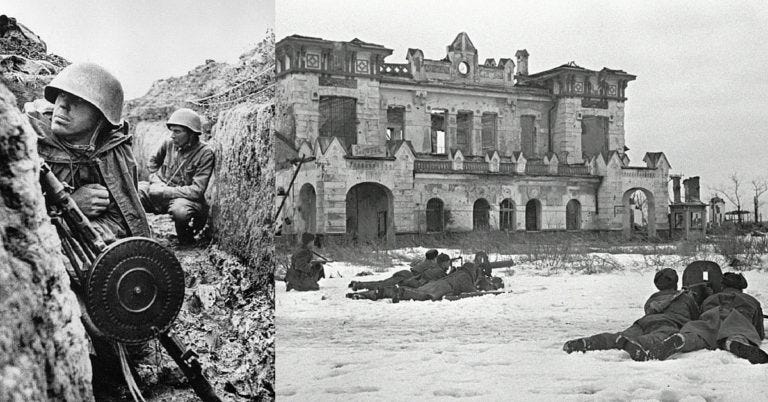
In the autumn of 1941, an eleven-year-old girl named Tanya Savitcheva kept a small notebook in Leningrad. She wasn’t writing a diary exactly — more a ledger of loss. Seven entries. Each recorded a death in her family, with the date and time, the way a child might if no adult was left to do it.
Zhenya died on Dec. 28 at 12:30 in the morning, 1941.
Grandma died on Jan. 25, 3 o’clock, 1942.
Leka died on March 5 at 5 in the morning, 1942.
The last entry read: The Savichevs are dead. Everyone is dead. Only Tanya is left.
Tanya herself was evacuated in 1944 — too late. She died that summer, aged thirteen.
Her notebook, nine pages in a child’s handwriting, became one of the most powerful documents of the Second World War. It was introduced as evidence at the Nuremberg Trials. It now rests in a Leningrad museum. And it was produced in a city that German planners had already written off as a corpse — a city of 2.5 million that Hitler had ordered obliterated, not captured.
This is the story of three cities in the autumn of 1941, and the autumn that broke the German war machine.
Background: Barbarossa’s Three Targets
When Germany launched Operation Barbarossa on June 22, 1941, Hitler’s plan rested on three simultaneous strategic objectives: Leningrad in the north, Moscow in the center, Ukraine and the Black Sea coast in the south. The theory was elegant. The reality was an empire too large to swallow.
By late summer, all three campaigns were grinding. The blitzkrieg that had dismantled France in six weeks was meeting something different on the Eastern Front — terrain, distance, and a willingness to absorb catastrophic losses that German planners had not modeled.
Three cities would define what that difference meant.
Odessa: Romania’s Pyrrhic Victory (Aug. 8 – Oct. 16, 1941)
Odessa, a Black Sea port in the Ukrainian SSR, became a target of the Romanian 4th Army and elements of the German 11th Army in August 1941. Due to the determined resistance of the Soviet 9th Independent Army and the Separate Coastal Army — supported by the Black Sea Fleet — it took the Axis forces 73 days of siege and four assaults to take the city. Romanian forces suffered nearly 93,000 casualties. Red Army casualties were estimated between 41,000 and 60,000.
The Soviets had one weapon the Romanians couldn’t answer: the sea. The Black Sea Fleet ran a continuous supply line into the port, and when the end came, it managed to evacuate approximately 350,000 soldiers and civilians from the city before the Romanians entered.
It was later described as the greatest independent success of the war by any minor Axis power. Which tells you something about the cost of success on the Eastern Front. The Romanian Army that limped away from Odessa was a diminished force. It would never fully recover.
What followed the conquest was darker still. During the occupation, approximately 280,000 citizens — mostly Jews — were massacred or deported. Odessa paid twice: once in the siege, once in what came after. World War II Database
Leningrad: The City That Refused to Die (Sept. 4, 1941 – Jan. 27, 1944)
Germany’s Army Group North reached the suburbs of Leningrad in August 1941. Land routes from the city to the rest of the Soviet Union were cut on September 8, beginning the siege. The Germans decided to bomb the city and starve its inhabitants rather than attempt to capture it.
Hitler’s directive, issued that September, was explicit: after the defeat of Soviet Russia, there could be no interest in the continued existence of this large urban center. Surrender negotiations, if offered, were to be refused. The population was not to be fed.
The daily ration for civilians fell to 125 grams of bread — no more than a thick slice. Starvation set in by December, followed by the coldest winter in decades, with temperatures dropping to -40 degrees Fahrenheit. Residents burned books and furniture to stay warm. Animals from the city zoo were consumed early in the siege, followed by household pets. Wallpaper paste made from potatoes was scraped off the wall, and leather was boiled to produce an edible jelly.
One lifeline held. Daring truck runs over the frozen Lake Ladoga — the “Road of Life” — brought small but significant supplies into the city. Over this route, 500,000 civilians were also evacuated throughout the siege. Trucks drove through German air attacks and across ice that was sometimes thin enough to flex beneath their wheels. Drivers who went through the ice were not recovered.
The siege lasted 872 days and caused an estimated 1.5 million deaths. Some historians have since classified it as a genocide.
The Symphony and the Occupied City
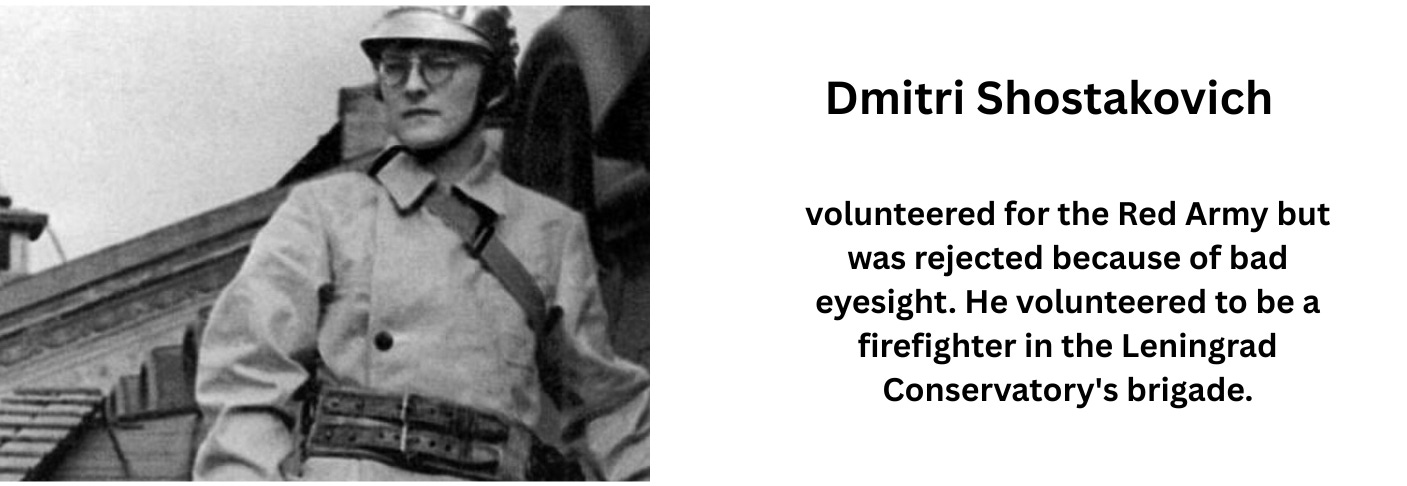
While Paris lived under German occupation — its concert halls offering Nazi-approved programming, its cultural life managed by Goebbels’ ministry — Shostakovich was writing a symphony inside the siege.
He began it in July 1941, in the first weeks of the German advance. “Neither savage raids, German planes, nor the grim atmosphere of the beleaguered city could hinder the flow,” he recalled. “I worked with an inhuman intensity I have never before reached.”
The score was eventually microfilmed and smuggled out via Tehran and Cairo. Arturo Toscanini and the NBC Symphony gave the American premiere on July 19, 1942, heard live by approximately 20 million people.
The Leningrad premiere came on August 9, 1942 — the very day Hitler had previously designated to celebrate the fall of the city with a lavish banquet at the Astoria Hotel. The Leningrad Radio Orchestra had lost most of its members to starvation. Military bandsmen and convalescing musicians were drafted in. Soviet artillery launched a pre-emptive strike on German batteries to secure the concert time. The performance was broadcast through loudspeakers across the city — and toward the German lines.
A German officer, listening from his position, is said to have remarked afterward that he understood, at that moment, that the city would never be taken. Whether or not those were his exact words, the sentiment was accurate. It wasn’t.
The contrast with Paris is the point. In the occupied French capital, cultural life continued under supervision. In Leningrad, an orchestra assembled from the barely living played defiance through loudspeakers at an army that had been ordered to erase them.
Moscow: The Tide Turns (Sept. 30 – Dec. 1941)
Operation Typhoon, the German drive on Moscow, launched on September 30. By late November, advance units could see the Kremlin’s spires. The Wehrmacht had never been closer to ending the war in the east.
On December 5, the Soviets counterattacked. It was the first strategic German retreat of the war. The blitzkrieg was over. What replaced it would last four more years.
Significance
These three sieges — running simultaneously, bleeding the Wehrmacht in three directions at once — collectively ended the German theory of the war. Odessa demonstrated that even secondary Axis forces would bleed white against Soviet resistance. Leningrad proved a city of millions could be starved for two and a half years and still not surrender. Moscow marked the moment the war in the east became what it would remain: a war of attrition that Germany could not win.
Hitler had designed Barbarossa to end in weeks. By January 1942, all three campaigns had failed in their original objectives. The Eastern Front would grind on for three and a half more years, consuming everything.
Tanya’s Notebook
Tanya Savitcheva was born in 1930. She was eleven when the siege began. She recorded the deaths of her sister, her grandmother, her brother, two uncles, and her mother in a small address book, using the letter tabs to organize the entries alphabetically by first name.
The final pages read: The Savichevs are dead. Everyone is dead. Only Tanya is left.
She was evacuated in 1944 and died shortly after, her health broken by starvation. She never fully understood the historical weight of what she had written.
Her notebook was presented at the Nuremberg Trials as evidence of German war crimes. It is now displayed in the Museum of the Siege of Leningrad in St. Petersburg. A small asteroid has been named for her. There is a monument.
None of it is adequate. But the notebook survives, and that may be enough.
Links
War History Online - siege of Leningrad - a collection of remarkable pictures