


PEARL HARBOR -21 MONTHS
It is March 1940. The guns are mostly quiet, but the silence is doing a lot of work.
Europe is seven months into a war that doesn’t quite feel like one yet. The Germans have not moved west. The French are behind the Maginot Line. The British are in France but not fighting. Journalists have started calling it the Phony War — drôle de guerre in French — and the phrase has stuck, though no one on either side finds it very funny.
In Washington, Franklin Roosevelt is watching. His country won't be in the war for another 21 months, but he is not indifferent, and in March 1940 he sends his Undersecretary of State on a mission to Europe that will tell him, and the world, exactly how close things really are.
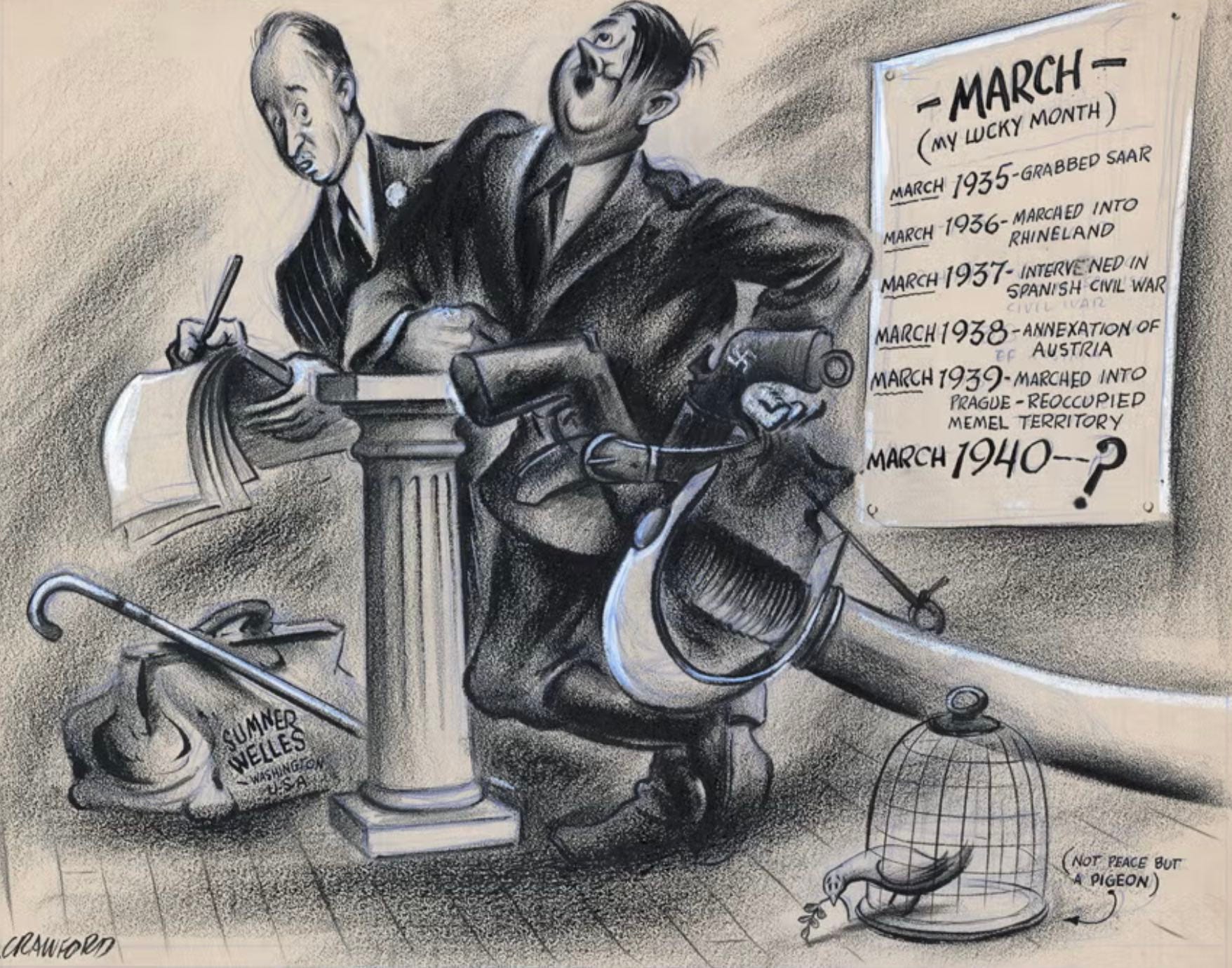
Sumner Welles arrived in Berlin in the first days of March, the latest stop on a diplomatic tour of the European capitals that Roosevelt had quietly set in motion. The mission’s stated purpose was to explore whether any basis for peace negotiations existed. Its real purpose was intelligence: Roosevelt wanted to understand the minds of the men running this war before the United States was forced to take sides.
Hitler received Welles on March 2nd. The meeting lasted two hours and produced almost nothing — which was itself informative. Hitler was not interested in peace. He was interested in knowing how seriously America intended to interfere. He was suspicious of Welles, suspicious of Roosevelt, and privately alarmed that the United States might be moving toward active opposition to German ambitions. He performed confidence, but the performance had an edge.
Welles went on to Rome, Paris, and London. In Rome, Mussolini was warm and expansive. In Paris, the government was distracted. In London, there was quiet resolve. He returned to Washington with a clear picture: there would be no negotiated peace. The war would continue, and it would get worse.
Russia defeats Finland in the Winter War
It got worse almost immediately. On March 12th, Finland signed a peace treaty with the Soviet Union, ending the Winter War. The Finns had fought with extraordinary courage against overwhelming odds for three and a half months, and the world had watched in admiration — and done nothing. Britain and France had debated intervention and delayed too long. Now Finland was gone, and the embarrassment of the Western Allies was complete.
Sixteen days later, Hitler and Mussolini met at the Brenner Pass, the high Alpine crossing between Austria and Italy. It was their first meeting in nearly a year. Hitler came with momentum and a plan. He told Mussolini that the attack in the West was coming, and coming soon. Mussolini, who had kept Italy nominally neutral while watching Germany’s early successes with envy and calculation, moved noticeably closer to the Axis that day. The two men parted in agreement — though Mussolini would not formally enter the war until June, the direction of travel was now clear.
The fall of Finland did more than expose Allied hesitation on the international stage. In France, it detonated a political crisis.
Édouard Daladier had been Prime Minister since April 1938. He was a tough, stocky man from Provence — they called him le taureau du Vaucluse, the bull of the Vaucluse — who had signed the Munich Agreement with Chamberlain and spent the months since trying to live it down. The Finnish disaster gave his enemies in the Chamber of Deputies the ammunition they needed.
On March 20th, Daladier lost a vote of confidence. He resigned the same day.
Paul Reynaud, who replaced him, was sharper, more aggressive, more convinced that France needed to fight this war rather than wait it out. He had opposed Munich. He had been warning about German intentions for years. He came to power with genuine determination — and he came too late. Reynaud would be Prime Minister for exactly 73 days before the French army collapsed and the government fled Paris.
But in March 1940, none of that was visible. Reynaud’s appointment felt like the beginning of something — France getting serious, France stepping up. It was the last political reset before the catastrophe, though no one knew it yet.
A World on the Edge
What March 1940 reveals, in hindsight, is the peculiar texture of a world on the edge. Everyone — Hitler, Mussolini, Daladier, Reynaud, Roosevelt, Welles — was acting on incomplete information, watching each other for signals, trying to calculate what came next. The Phony War had created a strange suspended moment, a political deep breath before the exhale.
Two months later, Germany invaded France and the Low Countries. Six weeks after that, France surrendered. The world Welles had toured in March consisted of cautious Europeans, probing Americans, and two dictators making deals on mountaintops. It would be unrecognizable by summer.
If you want to understand how catastrophes happen, study the months just before them. March 1940 is a masterclass in how clearly people can see danger coming and how thoroughly they can fail to act on it.
Three Days at the Brenner Pass
March 18, 1940 — Brenner Pass, Austria-Italy border, elevation 4,495 feet
The meeting was set for a train. Hitler’s private rail car was waiting at the Brenner station when Mussolini arrived.
They had not seen each other since the previous October. In the intervening months, Germany had conquered Poland while Italy watched from the sidelines. Mussolini had been telling his people — and himself — that Italy needed more time before it could enter the war. More steel, more fuel, more guns. Hitler had accepted this, barely.
At Brenner, Hitler changed the terms of the conversation. He laid out his plans for the western offensive in broad strokes: France and Britain would be struck, and struck hard. The defeat of France, he suggested, was a matter of weeks, not years. If Italy wanted to share in the victory, it needed to be present for the fight.
Mussolini listened. He did not commit to a date. But he left Brenner a different man than the one who had arrived. He was more convinced, more eager, more willing to believe that Hitler’s confidence was earned rather than performed.
Italy entered the war on June 10, 1940, eleven weeks later, four days before German troops marched into Paris.
A WORD FROM THE AUTHOR
The diplomatic maneuvering of March 1940 — envoys reading dictators in closed rooms, two strongmen sealing their pact on a mountaintop, a democracy reshuffling its leadership as catastrophe approached — is exactly the world Eddie Grant operates in, 75 years on.
That’s the world of the Eddie Grant Saga, my Paris thriller series featuring Eddie Grant — a wealthy former Special Forces commander living in Paris who takes on secret missions for the CIA as a volunteer, for no pay. If you enjoy history where the stakes are personal, start with Treasure of Saint-Lazare, chosen as top historical mystery of its year by Readers’ Favorite.
Thanks for reading
John Pearce
Washington, DC
Again, great stuff, John. I'm learning a lot and enjoying the great storytelling.