


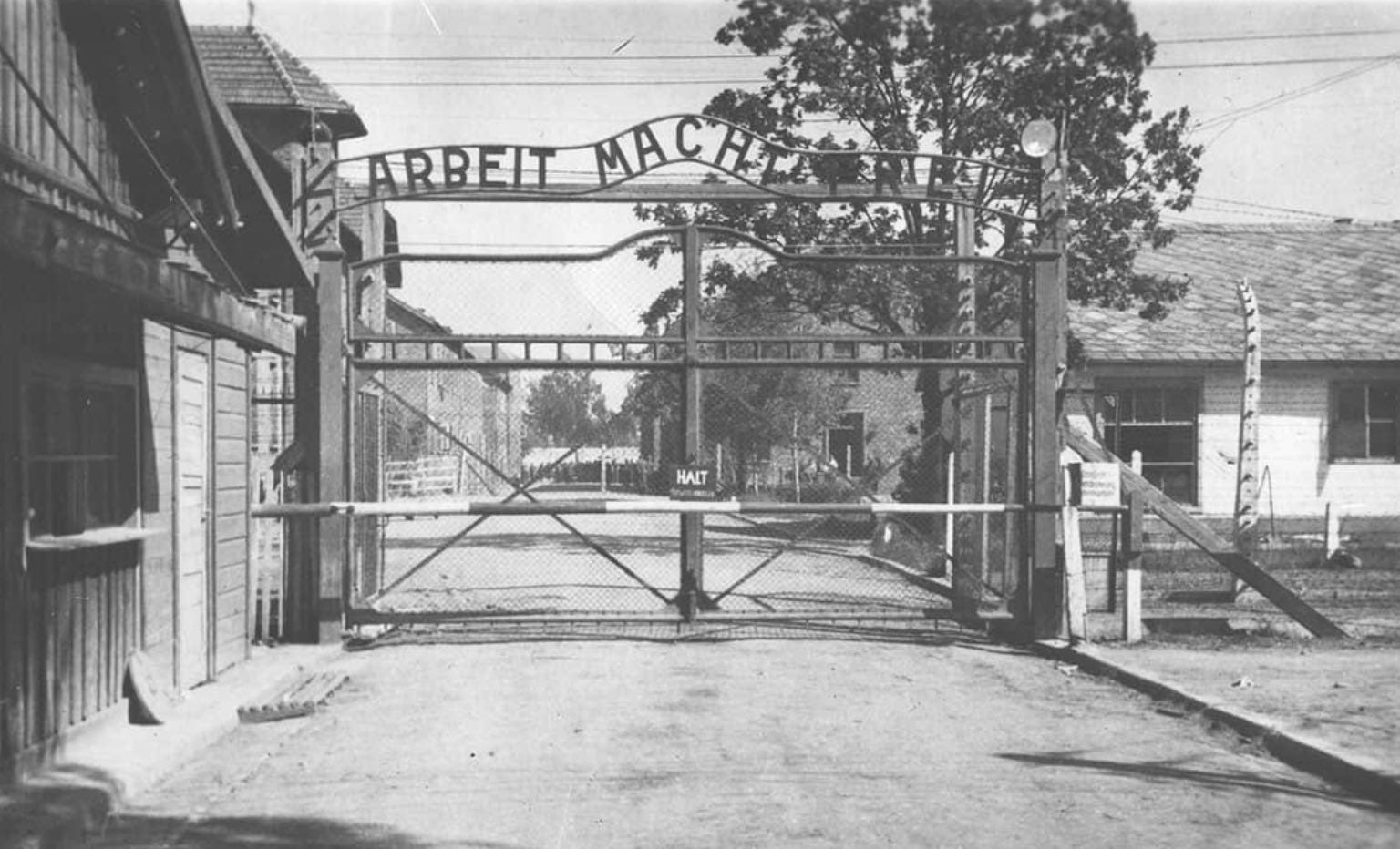
On the morning of March 30, 1942, a train pulled into Auschwitz carrying 1,112 men.
They had left France three days earlier, from the Compiègne transit camp north of Paris. Most had been arrested in the city the previous year — pulled from apartments, workplaces, and the streets of the Marais and Belleville — and held at Drancy and Compiègne while administrators processed their files and scheduled their departure.
At Auschwitz they were assigned registration numbers: 27533 through 28644. Their names ceased to matter to the Reich.
No selection took place that day. The gas chambers were not yet operating at the scale they would reach by summer. These men were marched into the camp and put to work.
By August 1942, 1,008 of the 1,112 were dead. Not gassed — worked, starved, and beaten to death across five months. A death rate of 91.6 percent.
Twenty-three survived the war.
Ten Weeks
The Wannsee Conference had taken place on January 20, 1942 — a ninety-minute meeting in a lakeside villa outside Berlin where fifteen senior Nazi officials coordinated the logistics of what they called the Final Solution to the Jewish Question. It was Reinhard Heydrich, chief of the Reich Security Main Office, who presented the plan. Not one of the fifteen men in the room objected. The bureaucratic language was deliberate: this was an administrative problem to be managed, not a crime to be hidden.
Ten weeks later, Convoy 1 left Compiègne.
The speed is worth pausing over. In less than three months, the decisions made in a Berlin suburb had been transmitted to occupied France, processed through the Vichy government’s administrative apparatus, and translated into a sealed train carrying over a thousand men eastward. No friction. No hesitation. The machine worked exactly as designed.
The Timeline
January 20, 1942: Wannsee Conference
March 27, 1942: Convoy 1 departs Compiègne
March 30, 1942: Convoy 1 arrives Auschwitz
1,112 men aboard
1,008 dead within five months
23 survivors at liberation
A French Story
This is where the history becomes uncomfortable — and it should.
The men on Convoy 1 had not been arrested by Germans. They had been arrested by French police, in Paris, during roundups in 1941, then processed through French transit camps administered largely by French officials under Vichy authority. René Bousquet, Secretary General of the Vichy police, had negotiated directly with the SS over deportation logistics. France was not simply occupied; in this domain, it was a willing administrative partner.
It is important to understand what Convoy 1 was not.
It was not the Vel d’Hiv.
The Vélodrome d’Hiver roundup — the event most associated with France and the Holocaust — did not occur until July 16–17, 1942, four months after Convoy 1 departed. That operation, in which French police arrested 13,152 people including 4,115 children and confined them in a Paris sports arena without food, water, or sanitation, became the defining image of French complicity.
But Convoy 1 reveals something the Vel d’Hiv can obscure: the machine was already running. Quietly. Efficiently. Before the world was paying attention. Before most people in France — Jews included — fully understood what “resettlement in the East” meant.
By the time the Vel d’Hiv roundup shocked even some Vichy officials with its scale, dozens more convoys had already departed or were being organized. In total, approximately 75,000 Jews were deported from France. Fewer than three percent survived.
The Streets Are Still There
In 1995, President Jacques Chirac became the first French head of state to formally acknowledge France’s responsibility for the deportations. Not the Germans, not the occupation — France. It had taken fifty-three years.
The men of Convoy 1 were gone before most of France understood what was happening. Before the yellow star decree. Before the Vel d’Hiv. Before resistance networks had organized to hide Jewish families in farmhouses and convents across the countryside.
They were gone in the ten weeks between a meeting in a Berlin villa and a train platform in Compiègne.
The streets they were taken from still exist. The Marais, where many of them lived, is today one of Paris’s most visited neighborhoods — galleries, restaurants, tourists with cameras. A few plaques mark the buildings where families were taken.
Most visitors walk past them without stopping.
A word from the author
Eddie Grant moves through those same streets in my Paris thrillers — past the old transit points, through arrondissements that carry the occupation in their stones even when the city would prefer to forget. The collaboration, the cowardice, the occasional quiet courage: they are the unacknowledged history beneath the Paris I write about.
Treasure of Saint-Lazare is available now. Paris Reckoning is coming soon.
Further Reading
Vélodrome d’Hiver Roundup — Wikipedia
France and the Holocaust — United States Holocaust Memorial Museum
Holocaust Encyclopedia - France
Chilling story of what happened before the Vel d'Hiv. Thanks for your great reporting, John.
Tragic, terrifying. How different are things with Trump today? He's not rounding up and deporting Jews to death camps, but the blind obedience to a dictator by sychophants and sadists is similar. Tragically too, today's mass murderers and genocidal criminals include the Israelis. A shameful aberration especially given the Holocaust.