


On March 9, 1933 — 93 years ago today — the new German government issued a stark warning to its Jewish citizens: vote in the upcoming municipal elections, and you will be arrested.
It was not a law. It was not even a formal decree. It was simply a threat, delivered with the casual confidence of a government that had already decided the rules no longer applied equally to everyone. Jews who showed up at the polls risked being hauled away by the SA — the Nazi paramilitary street fighters, the Brownshirts — who were by then operating in open coordination with the state.
This was not the beginning of the end for German Jews. It was barely the beginning of the beginning.
38 Days of Hitler
Hitler had been appointed Chancellor just 38 days earlier, on January 30, 1933. The restorationist politicians who manoeuvred him into the job — men who dreamed of turning the clock back to the Kaiser, not forward into something darker — believed they could control him. They were catastrophically wrong.
Within weeks, the new government was moving on multiple fronts simultaneously. On February 27, the Reichstag — Germany’s parliament building — burned. The Nazis blamed Communist arsonists. The next day, President Hindenburg signed the Reichstag Fire Decree, suspending the civil liberties guaranteed by the Weimar Constitution. Free speech, freedom of the press, the right to assembly — gone, overnight, by emergency order.
On March 5, the Nazis held Reichstag elections. Despite controlling the machinery of government and unleashing the SA against political opponents, they won only 43.9 percent of the vote. It wasn’t enough. So they arrested Communist deputies, barred them from taking their seats, and on March 23 passed the Enabling Act — which gave Hitler the power to govern by decree, without parliament. Germany’s democracy had lasted fourteen years.
The March 9 warning to Jewish voters came in the middle of all this, almost as an afterthought. It was, as the transition goes, the culmination of a series of anti-Jewish measures that had begun immediately after Hitler was appointed — and it would not be the last.
In the 1920s, most Jews were integrated into society. They served in the military and were active in business. Conditions began to worsen immediately after Hitler took power.
The new Nazi government didn't give much thought to the legality of the blizzard of new measures it put into force, but it did pass, by means of subterfuge and the cooperation of a supine parliament, the Enabling Act of 1933, which allowed the government to create laws without a vote of parliament and effectively ended the Weimar constitution.
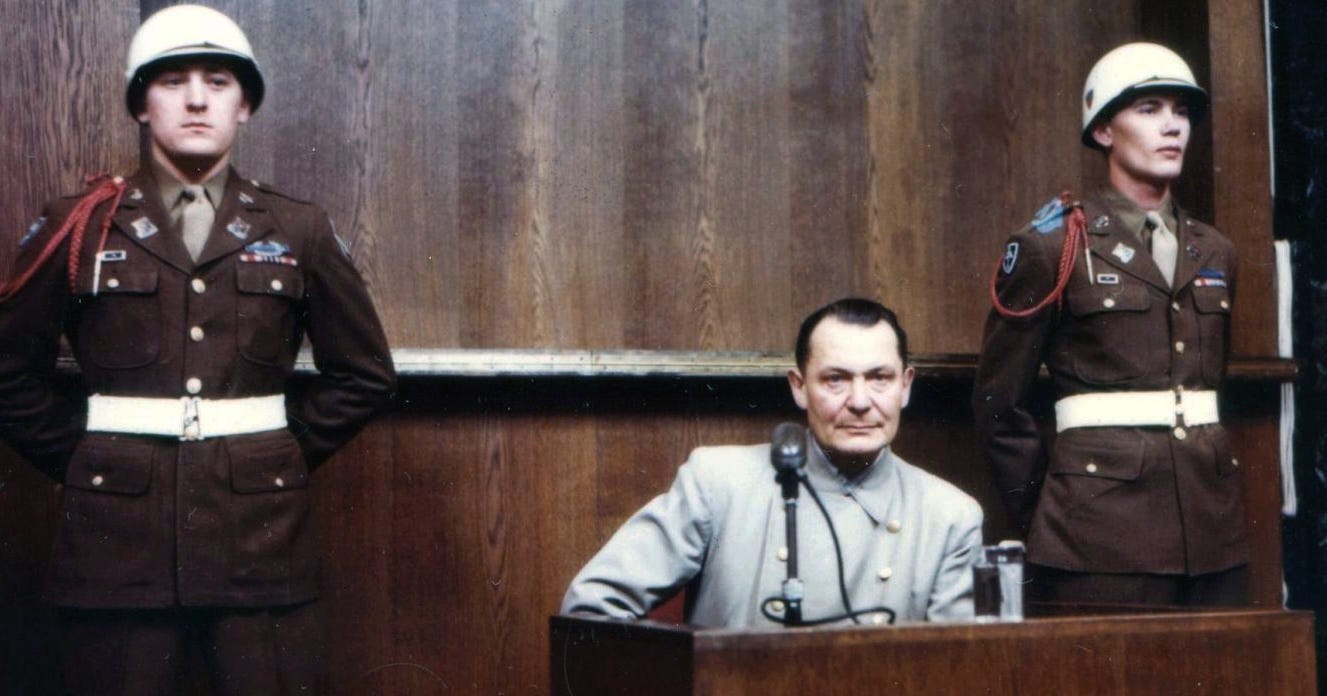
Hermann Göring, (usually anglicized to Goering) better known later as head of the Luftwaffe, was president of the Reichstag and made the change to the body's voting rules that made possible the Enabling Act. He remained president of the Reichstag through the war and was the most powerful of Hitler's aides until his promises that the Allied air forces could never bomb German cities proved to be hollow. His bombastic promise, “If as much as a single enemy aircraft flies over German soil, my name is Meier!” came back to haunt him.
As Göring's star set, he turned more to his avocations, especially art collection. He is a key behind-the-scenes character in my novel Treasure of Saint-Lazare. The 2025 Russell Crowe movie “Nuremberg” explores the interplay between Göring (Crowe) and the psychiatrist (played by Remi Malek) who examined him during his war crimes trial.
11 Days Later Dachau Opens
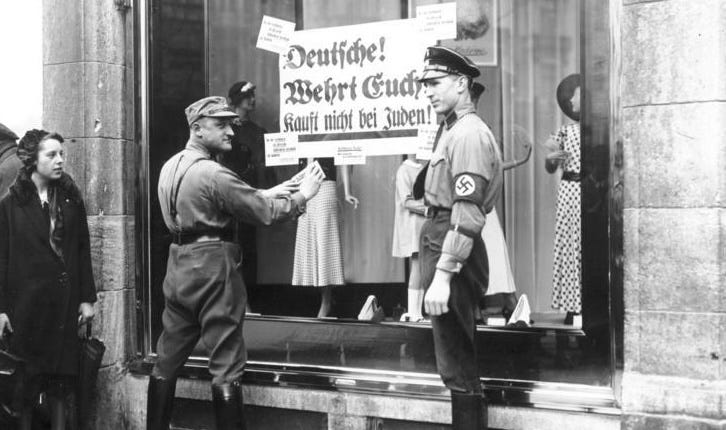
The steps came faster after March. On March 20, the Nazis opened Dachau, the first concentration camp, initially for political prisoners. On April 1, a one-day national boycott of Jewish-owned businesses was organised by the government — Brownshirts stood at shop entrances with signs telling Germans not to buy from Jews. A week later, the Law for the Restoration of the Professional Civil Service removed Jews from government employment. Jewish lawyers were disbarred. Jewish doctors were removed from state hospitals.
In May, students and Nazi activists held book burnings across Germany, incinerating works by Jewish authors, leftists, and anyone else deemed un-German. By July, the Nazi party was the only legal political party in the country.
The Nuremberg Laws of September 1935 codified what had been happening on the street into formal legal doctrine. Jews were stripped of German citizenship entirely. Marriage between Jews and non-Germans was forbidden. Jews could not employ German women under 45 as domestic workers. They could not display the German flag. They were, in the language of the state, no longer German.
Kristallnacht — the Night of Broken Glass — came on November 9-10, 1938. In two nights of coordinated violence, more than 7,500 Jewish businesses were destroyed, 1,400 synagogues burned, and around 30,000 Jewish men arrested and sent to concentration camps. Ninety-one Jews were killed outright. The German government then fined the Jewish community one billion Reichsmarks for the damage done to them.
Many Missed Off-Ramps
The road from March 9, 1933 to the Final Solution was not straight, and it was not inevitable. At many points, different choices could have been made — by German politicians, by ordinary citizens, by foreign governments who watched and did little.
But the direction was set early, in those first chaotic weeks of 1933, when the new government learned that it could threaten Jewish voters and face no consequences. That it could strip rights and face no consequences. That it could burn books, shutter businesses, and rewrite citizenship law — and the world would look away.
The Allied side could have been more helpful, to say the least. In May 1939, the MS St. Louis sailed from Hamburg carrying 937 Jewish refugees, most of them German, all of them desperate. Cuba refused entry to all but a few. The United States turned the ship away from Florida ports — close enough that passengers could see the lights of Miami. Canada also said no. The St. Louis was forced to return to Europe, where its passengers were parcelled out among Britain, France, Belgium, and the Netherlands.
When the Germans swept through Western Europe the following year, many of them were caught again. Historians estimate that roughly a quarter of the St. Louis passengers were ultimately murdered in the Holocaust.
The first transport of Jews to Auschwitz arrived in 1942. By the time the camp was liberated in January 1945, an estimated 1.1 million people had been murdered there. Most of them were Jewish.
It had taken twelve years. It had started with a warning not to vote.