


This Day in WWII | Tuesday, April 7 | Part-Time Parisian
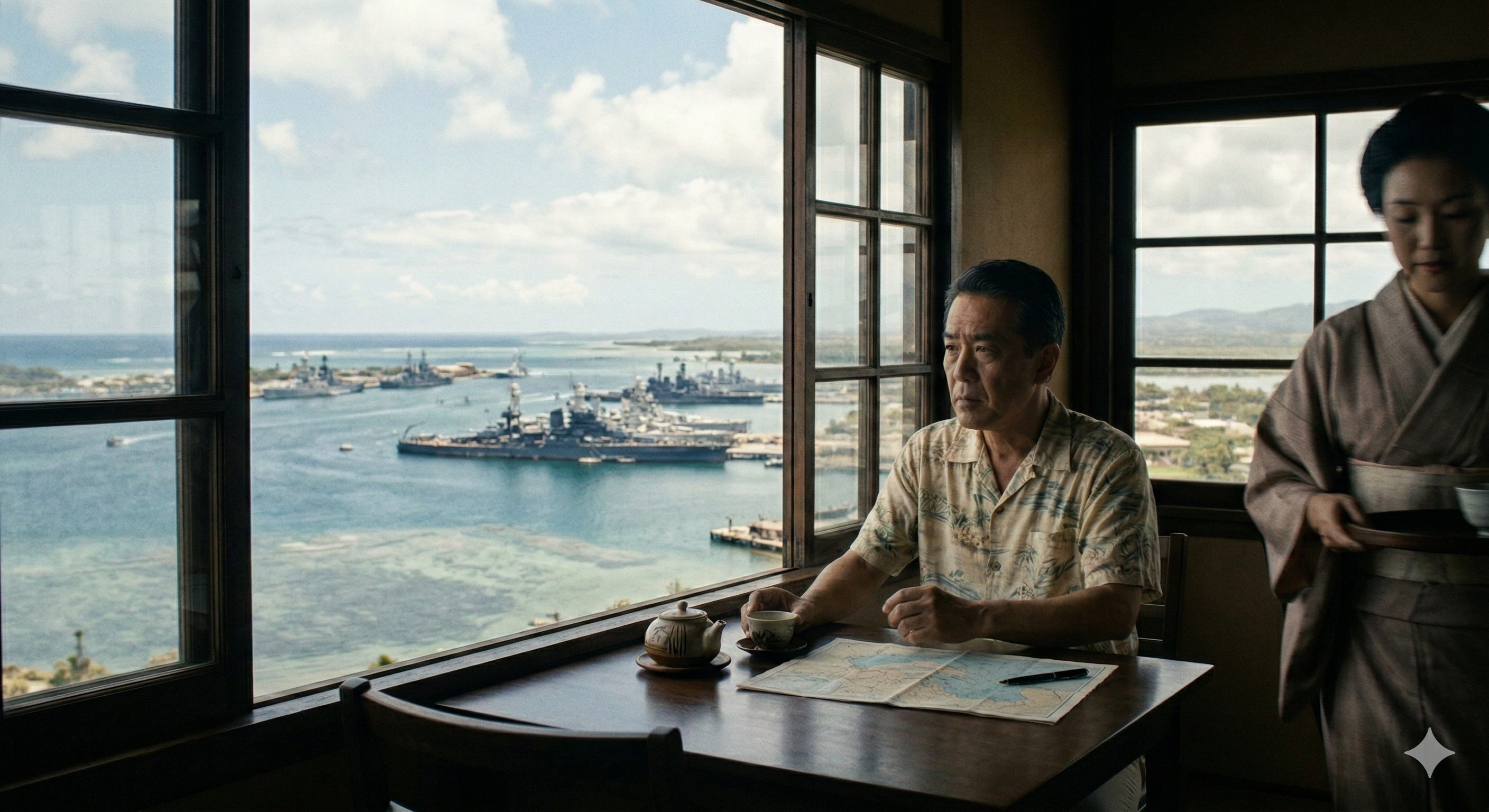
On a hillside above Pearl Harbor, a young man watched battleships move in the morning light. He wasn’t a general. He wasn’t a naval commander. He was, officially, a minor consular official who had arrived in Honolulu the first week of April 1941 — eight months before the bombs fell.
His name was Takeo Yoshikawa. And by the time he was finished, he knew the harbor better than most of the men stationed inside it.
Pearl Harbor wasn’t a surprise in the way we usually mean. It was studied.
The Professional
Yoshikawa was a trained naval intelligence officer who had washed out of flight school due to illness — a detour that redirected him toward something he was quietly extraordinary at: watching. When Japan’s Naval General Staff needed eyes inside Pearl Harbor, they gave him a new identity — “Tadashi Morimura,” vice consul — and a posting to the Japanese consulate in Honolulu.
He brought no gadgets. He ran no agents. He didn’t break into anything.
He rented cars and drove to hilltop viewpoints. He took tourist boat rides past the naval station. He found a teahouse on Alewa Heights with a clear sightline to the anchorage, became a regular, and let the geishas pour his sake while he counted warships. He is reported to have swum off Ford Island to gauge the water depth — critical intelligence, as it turned out, for modifying Japanese torpedoes to run shallow in the harbor’s confined waters.
His reports went to Tokyo through the consulate’s normal cable channels — encoded in a standard diplomatic cipher, routed through legitimate communications. Hidden in plain sight, in every sense.
By November 1941, his dispatches were shaping the final attack plan. The spacing of the battleships. The pattern of air patrols. The day of the week when the fleet was most predictably in port (Sunday, as it happened).
After December 7th, Yoshikawa was interned with the rest of the consulate staff and eventually repatriated to Japan. He was never prosecuted. For decades, he kept his identity secret. He died in 1993, his role largely unknown outside intelligence circles.
The Amateur — and the Uglier Story
Yoshikawa was not the only spy Japan had positioned in Hawaii.
Bernard Kühn was German, not Japanese. He and his family had settled in Honolulu in 1936, years before Yoshikawa arrived — and his path there was one of the stranger episodes of prewar espionage.
Kühn’s teenage daughter Ruth had become the mistress of Joseph Goebbels, Hitler’s propaganda minister. When Goebbels discovered that Ruth was half-Jewish, he faced a dilemma that was equal parts political and personal. His solution was characteristically ruthless: arrange for the Kühn family to be useful. He offered Bernard Kühn to Japanese intelligence as a paid asset and shipped the family to Hawaii.
One transaction: he protected himself from a political scandal, disposed of a liability, and delivered an intelligence asset to an ally. Goebbels, whatever else he was, understood leverage.
Kühn’s mission was to observe ship movements and, if war came, use a system of light signals from his beachfront home to communicate with Japanese submarines offshore. The system — flashes visible from the water at pre-arranged times — was exactly as amateurish as it sounds. Tokyo reviewed his proposal and largely set it aside. They had Yoshikawa.
Kühn was arrested on December 8th, 1941 — one of the first enemy agents taken into custody after the attack. He was sentenced to death, later commuted to fifty years. He was deported to Germany in 1946.
What Yoshikawa Got Right That Fictional Spies Get Wrong
No dead drops. No car chases. No seduction over cocktails.
Yoshikawa’s most powerful tool was patience — and the willingness to be boring. A man who drinks tea on a hillside and watches ships is invisible. A man who breaks into an admiral’s office is not.
Intelligence professionals still cite his case as a model of open-source collection: the most dangerous information is often the kind anyone could gather, if they were willing to sit still long enough to gather it.
The Paris Connection
The Kühn story has a long shadow that stretches back to Europe — specifically to the same apparatus that was reshaping Paris in those years.
Goebbels wasn’t just a propagandist. He was running a shadow operation that placed personal loyalty, blackmail, and political survival ahead of any formal intelligence structure. The machinery that sent the Kühn family to Hawaii was the same machinery dictating what Parisians read in their newspapers, heard on their radios, and saw on their cinema screens. The same transactional ruthlessness. The same contempt for the people being moved around the board.
Paris under occupation was managed by men who thought in exactly those terms: everyone is either useful or expendable. Ruth Kühn’s story is a footnote to history, but it’s a reminder of what that logic cost ordinary people — even those, like her, who were caught inside the apparatus itself.
Why It Still Matters
Pearl Harbor is remembered as a military catastrophe. It’s less often remembered as an intelligence triumph — for Japan.
Yoshikawa proved that open-source observation, requiring no technology more sophisticated than a rented car and a head for detail, could shape the outcome of a battle that changed the course of the war. The United States had counterintelligence assets in Hawaii. The warning signs were there. What failed wasn’t collection — it was analysis. The dots existed. No one connected them.
The “Crow’s Nest” Teahouse
The Shuncho-ro Teahouse (now known as the Natsunoya Tea House) remains one of the most significant sites in the history of WWII espionage. Perched on the hills of Alewa Heights, it offered Yoshikawa a “God’s-eye view” of the Pacific Fleet.
The Japanese consulate often held parties there, providing the perfect cover for Yoshikawa to bring a telescope to the second-floor windows. While U.S. Navy officers were often present in the same building, enjoying the hospitality, Yoshikawa was busy documenting the arrival of the USS Arizona and the USS Pennsylvania. It is a chilling reminder that in 1941, Hawaii was a place where “the front line” was a dinner table with a view.
That lesson has driven intelligence reform ever since, from the Church Committee hearings to the 9/11 Commission report. We had the information. We didn’t know what we had.
Kühn’s story is different and smaller: an amateur inserted by personal leverage, whose signal scheme was too crude to be useful. But his path to Hawaii — routed through Goebbels’s bedroom politics and Nazi racial calculus — is a reminder that wartime espionage didn’t recruit only from patriotism. It recruited from fear, ambition, and the wreckage of people’s private lives.
Yoshikawa never carried a weapon. He didn’t need one — his intelligence was the weapon. Eddie Grant understands that calculus better than most.
Brought to you by my Eddie Grant novels
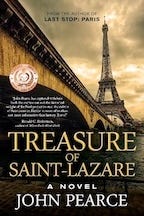
The Eddie Grant Saga follows a wealthy former Special Forces commander who volunteers for CIA missions when the agency needs someone who can operate outside official channels — and who knows that the most dangerous operatives are the ones nobody sees coming. The series begins with Treasure of Saint-Lazare, recognized as a top historical mystery by Readers’ Favorite.
If this landed for you — subscribe so you don’t miss the next one. And if you know a fellow history reader who’d enjoy it, a share goes a long way.
Further reading
Warfare History Network: Takeo Yoshikawa and the Spies Behind the Pearl Harbor Attack
Another excellent piece. Who knew? And also very interesting about Goebbels and the Jewish-Nazi spy.
Hey 👋