


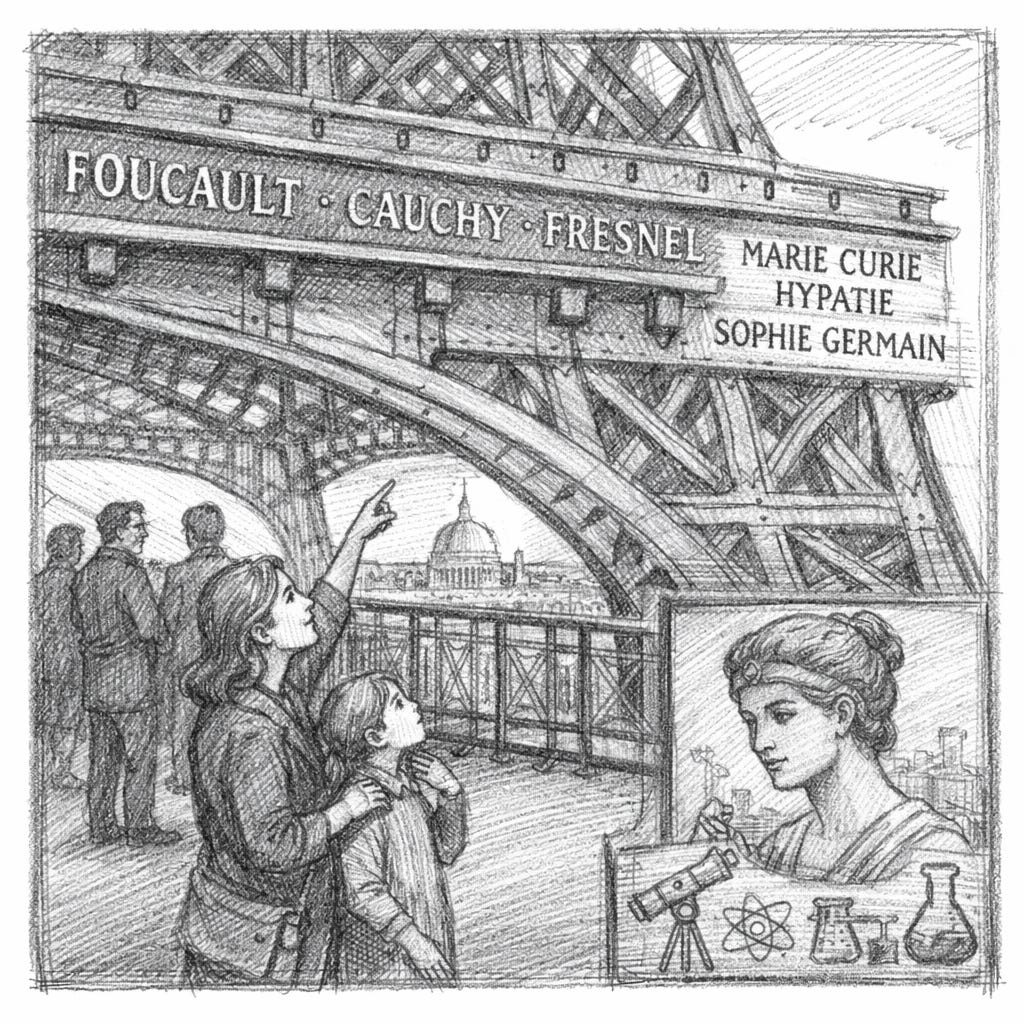
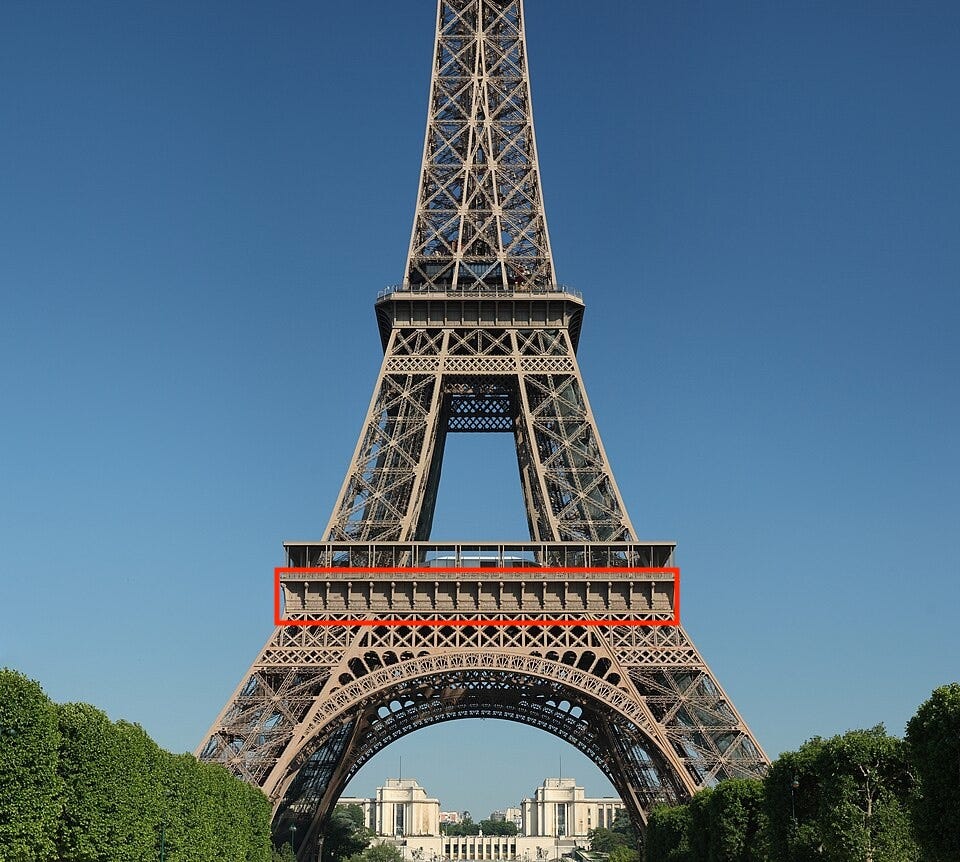
At the first level of the tour Eiffel, the wide iron gallery just above the swirl of visitors and the wind off the Seine, something remarkable has been quietly hiding in plain sight for more than a century. Encircling the iron structure are the names of seventy-two scientists—Foucault, Fresnel, Cauchy, Belgrand—picked in the late 1880s as emblems of French scientific progress. Their names, spelled out in gold, were meant to announce to the world that modernity had arrived.
There was only one problem: every one of those names belonged to a man.
That is about to change, in gold letters.
A new initiative led by the association Femmes & Sciences, in partnership with the City of Paris and the Société d’Exploitation de la Tour Eiffel, will add the names of 72 women scientists to the monument. Astronomers, mathematicians, chemists, physicians, engineers—women whose work shaped modern science but whose names were too often relegated to footnotes, if they appeared at all.
The project, called Hypatie, takes its name from Hypatia of Alexandria, the ancient mathematician and astronomer murdered in the fifth century and often described as the first known woman scientist. It is a pointed choice.
New here?
Start with Lauren, a free espionage novella that introduces Eddie Grant and the world behind my novels. It's just the thing for Paris lovers.
The omission of women from the Tower’s original “scientific pantheon” was not malicious; it reflected who was allowed into laboratories, universities, and academies at the time. In the nineteenth century, women were largely excluded from universities, laboratories, academies, and recognition. Their absence on the Tower simply mirrored their erasure elsewhere.
What makes this moment powerful is that it does not erase the past—it answers it.
The proposed list reads like an alternative history of science. Some names are familiar: Marie Curie, whose discoveries reshaped physics and chemistry; Sophie Germain, who advanced number theory despite being barred from formal education; Irène Joliot-Curie, Nobel laureate in her own right. Others will be new even to well-read visitors: Jeanne Baret, who circumnavigated the globe disguised as a man to pursue botany; Alice Recoque, a pioneer of early computing; Anita Conti, France’s first oceanographer; Marthe Gautier, whose role in identifying trisomy 21 was long minimized.
Seen together, the list tells a different story of progress—one built not only in grand institutions, but in persistence, improvisation, and quiet brilliance.
Artist and project initiator Benjamin Rigaud describes Hypatie as an act of contemporary art as much as historical correction. The Tower has always been more than iron and rivets; it is a statement. Inscribing these names, he argues, makes equality visible at the literal heart of Paris. Isabelle Vauglin, president of Femmes & Sciences, puts it more bluntly: this is about restoring memory to women whose contributions were “effacées.”
Importantly, none of this is being done lightly. A scientific and heritage committee—bringing together historians, engineers, conservation experts, and leading scientists—has been tasked with ensuring that the additions respect the Tower’s protected status. Symbolism matters, but so does stewardship.
When these seventy-two new names take their place, the Eiffel Tower will still speak of progress, as it did in 1889. But it will finally be speaking in a fuller voice.
Next time you stand on the first floor and look around, remember: monuments don’t just preserve history. Sometimes, they correct it.
Status of the project…
On January 26, 2026, the City of Paris publicly revealed the full list of 72 women scientists proposed for the Tower.
Before they can be physically engraved, this list has to be reviewed and validated by several scientific academies (in sciences, technologies, and medicine) and by the city’s heritage bodies.
Once approved and the practical heritage work is arranged, the current plan aims for installation in 2027 — a symbolic year that echoes the Tower’s historic narrative and allows the careful conservation work needed on a world heritage-protected structure.
The intention is for the women’s names to be engraved and painted in gold, using the same typography and style as the existing frieze of names that circles the Tower’s first floor.
This ensures that the new names won’t feel like separate plaques or stickers, but rather a permanent and cohesive addition to the Tower’s architectural celebration of scientific achievement.
New here?
Start with Lauren, a free espionage novella that introduces Eddie Grant and the world behind my novels. It’s just the thing for Paris lovers.
Source: City of Paris website