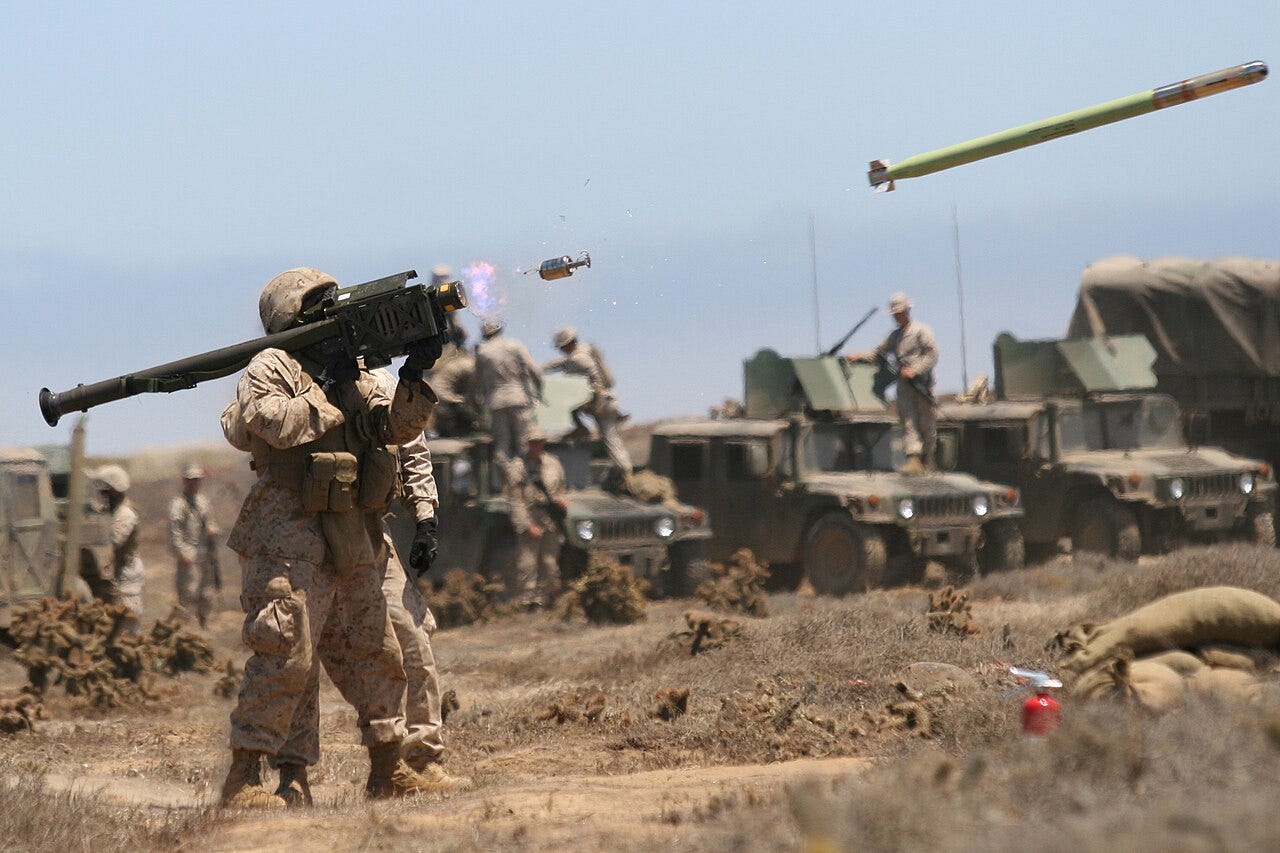
On April 3rd of this year, an American F-15E Strike Eagle — one of the most sophisticated combat aircraft ever built — was shot down over Iran by a weapon one soldier could carry on his shoulder. President Trump later said the Iranians “got lucky” with a shoulder-fired heat-seeking missile that was “sucked right into the engine.” Lucky, perhaps. But the threat was hardly a surprise to anyone who had been paying attention.
Man-portable air defense systems — MANPADS in the acronym the defense world favors — have been the scourge of both military and civilian aviation for more than sixty years, and were so prominent at one time that I wrote an entire novel featuring them. The attempted use of a shoulder-fired missile to shoot down an Airbus at DeGaulle airport was the central set piece of my novel Last Stop: Paris, the second in my Eddie Grant Saga. Kirkus called it “part thriller, part mystery, and all rollicking ride.”
The plot revolved around a man who had been an Iraqi spy in Kuwait, and whose son Eddie Grant killed, traded a load of gold for several pallets of Russian Strela manpads at the Bulgarian port, Burgas. Later, at DeGaulle airport, he fails to hit the airbus but does shoot down a military helicopter gunship.
The story seems to have struck a chord, as Last Stop: Paris remains a steady seller.
The United States and the Soviet Union developed shoulder-mounted missiles in parallel during the early Cold War, deploying their first systems in the 1960s: the American Redeye and the Soviet Strela-2. The concept was straightforward. Give an infantryman the ability to threaten enemy aircraft without requiring a radar installation, a vehicle, or a crew of specialists. Point, fire, walk away.
Both superpowers then did what superpowers do: they manufactured them by the hundreds of thousands and exported them promiscuously. The Arms Control Association estimates that more than one million MANPADS have been produced since their introduction, and that at least 102 countries have held them in their arsenals. The Soviet contribution to this flood was particularly consequential. Decades of Cold War overproduction and aggressive arms exports scattered these weapons across the developing world, and their effects are still being felt.
Manpads are widely credited with forcing the Soviet Union's forces out of Afghanistan in 1988.
The technology evolved in generations. Early systems were simple infrared seekers that could only chase an aircraft’s hot exhaust from behind — hence “tail-chase weapons.” Later generations added all-aspect targeting, better countermeasure resistance, and eventually the imaging infrared guidance now found in Russia’s fourth-generation Verba system, which Iran was reportedly negotiating to purchase from Russia as recently as last year, in a reported $589 million deal.
The proliferation problem became dramatically visible in 2011, when the fall of Muammar Gaddafi’s regime in Libya unleashed one of the largest single arms-looting events of the modern era. Thousands of MANPADS, many of them poorly secured even before the chaos, vanished into the black market and began surfacing across North Africa and the Middle East. The Small Arms Survey subsequently tracked illicit MANPADS in 32 countries on five continents.
The civilian aviation threat has always been the nightmare scenario. More than fifty attacks on civilian aircraft have been recorded, mostly in Africa and Asia, and the 1994 shootdown of the plane carrying the presidents of Rwanda and Burundi — widely considered the trigger for the Rwandan genocide — stands as the grimmest illustration of what these weapons can do when aimed at the wrong target.
Colin Powell said in 2003 that there was “no threat more serious to aviation” than shoulder-fired missiles. Two decades of international effort — export controls, stockpile destruction programs, diplomatic agreements — have made a dent without solving the problem. The F-15E going down over the Zagros Mountains last week is a reminder that a weapon one person can carry remains capable of changing the course of events.
Wikipedia has a detailed page on manpads.
John Pearce
Washington, DC