


This Day in WWII | Tuesday, May 19, 2026 | Part-Time Parisian
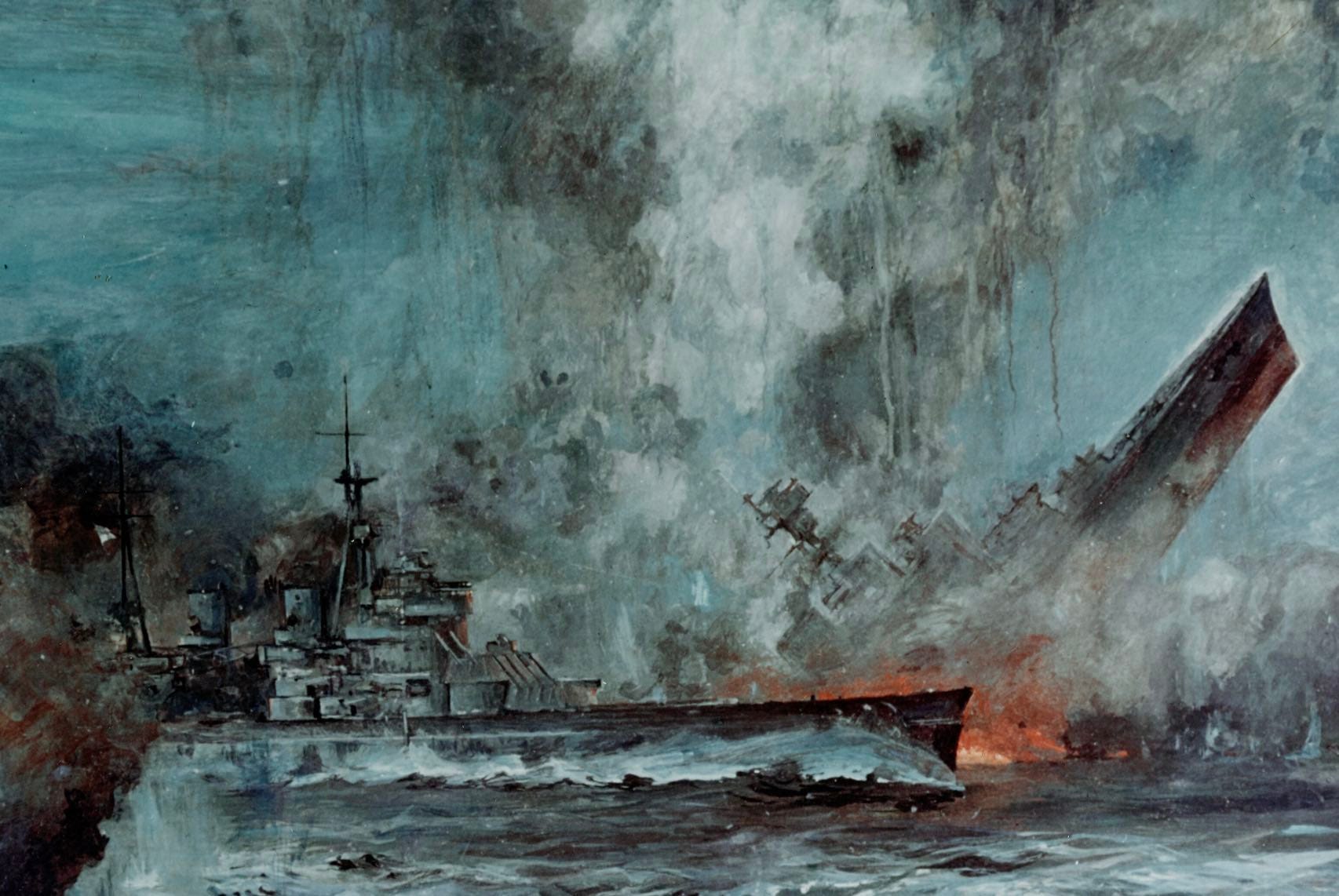
At 6:01 a.m. on May 24, 1941, HMS Hood — the largest warship in the world, the pride of the Royal Navy, a floating symbol of British imperial power — ceased to exist.
Not in the way ships usually die. Not slowly, with time to lower boats and call for help. The Hood went in a single, catastrophic instant — a German shell finding her ammunition magazine, the explosion tearing her in half so violently that witnesses on nearby ships couldn’t process what they were seeing. One moment she was there. Then she simply wasn’t.
Of her 1,415 crew, three men survived.
The ship that killed her, the battleship Bismarck, had been at sea for less than a week.
The Most Feared Ship Afloat
By the spring of 1941, the German surface fleet posed a nightmare threat to Allied Atlantic convoys. Submarines were doing terrible damage — but a capital ship loose in the North Atlantic could ravage supply lines in ways no U-boat could. Admiral Erich Raeder understood this, and he had the weapon to do it.
The Bismarck was the largest, most heavily armed battleship Germany had ever built. At 50,000 tons fully loaded, with eight 15-inch guns and armor belt thick enough to defeat most shells at combat ranges, she was designed not just to fight — she was designed to be unsinkable. Her crew of more than 2,200 men believed it. So did the British, which is why they wanted her destroyed before she ever reached the open Atlantic.
On May 18, 1941, the Bismarck and the heavy cruiser Prinz Eugen slipped out of Gotenhafen under Operation Rheinübung — Rhine Exercise. Their orders: break into the Atlantic, destroy Allied shipping, and return to port. The designated port was Brest, on the northwest coast of occupied France.
British intelligence was watching. A Swedish cruiser spotted the German squadron in the Kattegat. Swedish naval attaché reports filtered back to London — and to a British agent in Stockholm who wired the news to Whitehall within hours. By the time the Germans anchored in a Norwegian fjord near Bergen to refuel, a reconnaissance Spitfire had photographed them from 26,000 feet.
The Royal Navy began its intercept.
The Denmark Strait
The gap between Iceland and Greenland is only about 300 miles wide — and in May 1941, much of that was choked with pack ice, narrowing the navigable channel further. It was the most likely route for a breakout, and the Admiralty knew it. HMS Suffolk and HMS Norfolk were already on patrol there when, on the evening of May 23, Suffolk’s radar picked up two large contacts emerging from the fog.
She shadowed them through the night, radioing position reports every thirty minutes.
The Hood and the new battleship Prince of Wales raced to intercept.
What happened at dawn on May 24 lasted less than ten minutes. Hood opened fire at extreme range — too extreme, her shells falling short, her own deck armor dangerously thin at the angles the Germans were firing from. The Bismarck’s fifth salvo found her. A shell or shells penetrated to the after magazine. The explosion was so violent that fragments of the Hood were found floating miles away. Both her bow and stern rose briefly above the water, then she was gone.
The Prince of Wales, still working up — her civilian shipyard technicians were literally aboard when the battle began — fought on alone for a few more minutes, scoring three hits on the Bismarck and causing flooding that would matter later. Then she broke off, damaged, into the mist.
But the Bismarck was not unscathed. Two of those Prince of Wales hits had punctured fuel tanks in her bow, leaving a spreading oil slick behind her and forcing a decision: continue the mission leaking fuel, or head for port. Admiral Günther Lütjens chose to press on briefly, then turned for France. Brest — still three days away.
The Royal Navy turned the entire Atlantic upside down to stop her.
The Hunt
What followed was the largest naval chase in history. Dozens of ships converged from multiple directions. The Bismarck’s position was lost for critical hours on May 25 — the tension in the Admiralty was excruciating — then found again when a Catalina flying boat spotted the oil slick southeast of where the fleet expected her.
She was closer to Brest than to her pursuers. Under normal circumstances, she would have made it.
But she didn’t have normal circumstances.
On the evening of May 26, fifteen obsolete Swordfish torpedo bombers — canvas-and-wire biplanes that flew slower than the Bismarck’s antiaircraft systems were designed to engage — launched from HMS Ark Royal in heavy seas. It was nearly suicidal. The Swordfish flew through everything the Bismarck could throw at them and pressed their attacks to near point-blank range.
Two torpedoes hit. One struck amidships and caused little damage. The other hit the stern, jamming the Bismarck’s rudders hard to port. The most powerful battleship in the world could no longer steer a straight course.
She circled through the night, fighting off destroyer attacks, unable to run. Her crew sent final messages to Germany. Some men wrote letters. Lütjens signaled Berlin: Ship unmaneuvarable. We will fight to the last shell.
At dawn on May 27, the battleships Rodney and King George V closed in for the kill.
The French Connection — and What Came After
The Bismarck was heading for Brest, and that detail matters more than it might seem.
Brest, in the German-occupied Brittany region, had become a critical base for the Kriegsmarine’s Atlantic operations. U-boat pens had been built there. The heavy cruisers Scharnhorst and Gneisenau were already in port when the Bismarck set out. Had she arrived, the combined force based at Brest would have represented a permanent, constant threat to every Allied convoy crossing the Atlantic.
But the math of the Bismarck revealed a problem the Germans hadn’t fully solved. There was only one dry dock on the entire Atlantic coast large enough to service a ship her size — the Normandie Dock at Saint-Nazaire, 300 miles south of Brest, built in the 1930s to accommodate the great French ocean liner.
In March 1942, the British sent a converted destroyer, packed with delayed-action explosives, ramming it into the dock gates and destroying them in one of the war’s most audacious raids. The Saint-Nazaire Dock would never serve the German navy. It is still, to this day, not fully restored.
The Bismarck’s reach extended further than her guns.
Why It Still Matters
The loss of the Hood shattered something in the British public’s confidence in ways the government scrambled to contain. She had been more than a warship — she was a symbol, a kind of floating embodiment of British naval supremacy, sent on world tours between the wars specifically to display that supremacy. Her absence left a hole that no single sinking could easily fill.
And yet: six days later, the Bismarck was gone too. Three survivors from the Hood. About 114 from the Bismarck — out of more than 2,200 men. The Royal Navy recovered nearly 110 men before a U-boat warning forced them to abandon the rescue. Hundreds more died in the water, within sight of help.
The sinking effectively ended Hitler’s ambitions for surface-fleet warfare in the Atlantic. He would not risk another capital ship so openly again. The war at sea would be fought beneath the water.
But for one week in May 1941, two of the greatest warships ever built found each other in the cold North Atlantic — and neither came home.
The Three Who Survived
When the Hood went down, the sea temperature was near freezing. Three men survived: Able Seaman Robert Tilburn, Midshipman William Dundas, and Ted Briggs, who was 18 years old. They clung to wreckage for three hours before HMS Electra found them. Briggs was the last survivor to die — in 2008, at age 85. He never stopped speaking about the men he lost. Of the 1,415 who died, most were never recovered. The wreck wasn’t located until 2001, lying in more than 9,000 feet of water southwest of Iceland.
A Word from the Author
The Bismarck was racing for Brest when she was caught — and Brest, in the Eddie Grant novels, is a city that still carries its wartime scars just below the surface. The entire Brittany coast was transformed by German occupation, its ports militarized, its people caught between collaboration and resistance in ways that still complicate French memory. Eddie understands that particular moral fog better than most — it’s the same fog that shaped the Paris he operates in. Treasure of Saint-Lazare is available from Amazon. Coming soon: Paris Reckoning, first in a new series.
John Pearce
Washington
Could the Hood be a metaphor for something? A giant, muscle-bound but unprepared country, for instance?
Keep them coming! Thanks