


In the spring of 1943, the men planning Operation Husky — the Allied invasion of Sicily, still four months away — needed North Africa cleared. Every week the Axis held Tunisia was another week Sicily could be reinforced, another week the Mediterranean remained contested, another week the road to Rome stayed closed. The clock was running.
Standing between the Allies and that clock was a line of French concrete.
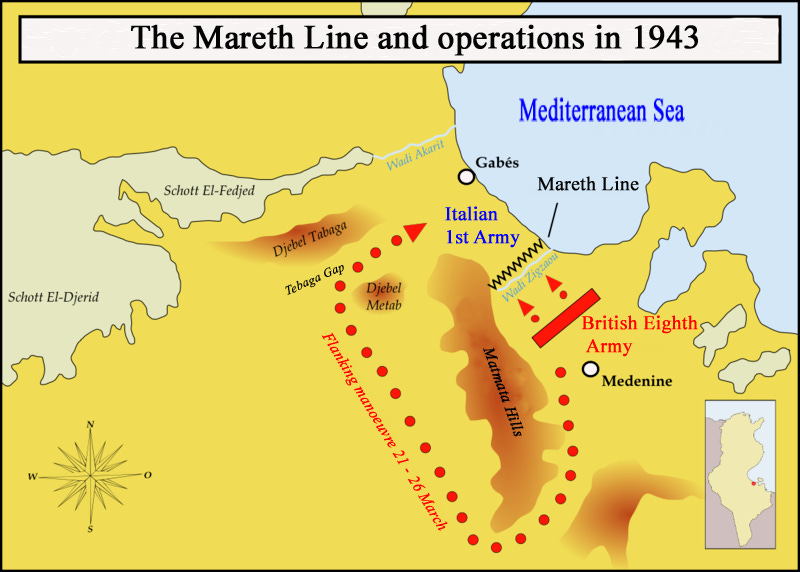
The Mareth Line had been built in the 1930s by French engineers who feared an Italian thrust from Libya. Blockhouses, anti-tank ditches, minefields, and a steep-sided wadi called the Zigzaou — twenty-two miles of fortification, anchored on the Mediterranean coast and running inland to the Matmata Hills. The French never used it. The Italians, whom it was designed to stop, ended up garrisoning it. History has a dark sense of humor.
By March 1943 the line was held by General Giovanni Messe’s Italian First Army, stiffened by German armor and artillery. And behind its construction — behind the doctrine, the tactical thinking, the months of fighting retreat across 1,400 miles of desert — stood the ghost of a man who was no longer there.
Erwin Rommel had built the Afrika Korps into one of the most feared fighting forces of the war. He had humiliated the British at Tobruk, driven them back to the gates of Cairo, turned the Western Desert into his personal theater. But by early 1943 the theater was dark. Ultra intercepts gave the Allies his every move. American industrial output was swamping his supply lines. At Medenine on March 6, he threw his armor at a British defensive line that was waiting for him — 400 anti-tank guns, pre-sighted and pre-registered — and lost 52 tanks in a single afternoon without gaining a yard.
Rommel leaves Africa
Three days later, sick, exhausted, and recalled by Hitler, he flew out of Tunisia. He would never return to Africa.
Command passed to Messe, an able officer handed an impossible brief. The Afrika Korps was depleted, undersupplied, and leaderless at the top. But the Mareth Line was still formidable, and Messe intended to use it. The army Rommel had forged would fight his battle without him.
Montgomery’s plan was characteristically methodical: Operation Pugilist, a frontal assault on the night of March 20. Two infantry battalions of the 50th Northumbrian Division would punch through the line near Zarat, cross the Wadi Zigzaou, and open a gap for armor to pour through. Simultaneously, the New Zealand Corps under Lieutenant General Bernard Freyberg would execute a wide flanking sweep south and west through the Matmata Hills — a march the French had considered impassable in the 1930s, before British long-range desert patrols found a navigable track they named Wilder’s Gap.
The frontal assault went wrong from the first hour. Rain turned the wadi bottom to mud. Tanks bogged or were torn apart by German 88s before they crossed. Infantry who made it over the Zigzaou found themselves isolated, cut off from armor and anti-tank support. By March 22, Messe’s counterattack had recaptured most of the ground, taken 200 British prisoners, and destroyed 35 tanks. The bridgehead was collapsing.
Montgomery pulled back and pivoted. This is the moment his critics rarely acknowledge — the willingness to kill a failing plan before it became a catastrophe. He stripped forces from the stalled coastal attack and threw them behind Freyberg’s New Zealanders. The flanking hook, already moving through the hills, became the main effort.
Mareth was the first domino
The New Zealanders had been in this desert for three years. They were arguably the finest infantry formation in the Eighth Army — patient, resourceful, and by 1943 savagely experienced in the specific violence of desert warfare. Reinforced with British armor, additional artillery, and Free French units under the formidable General Leclerc, Freyberg’s corps pushed through the Tebaga Gap on March 26. The Western Desert Air Force flew over 700 sorties a day above them, hammering Axis defensive positions without pause.
Messe shifted his armored reserves — including the 21st Panzer Division — west to meet the threat, and for a moment the line held. The Germans were good, even then. But the weight was too great. On March 28, British patrols crossed the Wadi Zigzaou and found the Mareth positions abandoned. The Axis had slipped north toward the Wadi Akarit, the last natural defensive line before the open plain that ran up to Tunis.
They held Wadi Akarit for a week. Then that line broke too. In May, cornered in the ruins of their Tunisian bridgehead, 275,000 German and Italian soldiers — the survivors of three years of desert fighting — laid down their arms. It was the largest Axis surrender of the war in the African theater.
The road to Sicily was open. Operation Husky launched July 10. Within six weeks, the Allies held the island. Within months, Italy was invaded, Mussolini fell, and the road that would lead — eventually, bloodily — to the beaches of Normandy was running.
Fact to Fiction
Among those who never saw any of it was a young Afrika Korps soldier captured weeks earlier, during the disaster at Kasserine Pass in February. By the time Montgomery’s men crossed the Wadi Zigzaou, he was a prisoner of war hired out to work on a dairy farm in the Catskills, headed toward a life he could not yet imagine. That story is coming in my novel in progress Washington Square.
A word from the author
The men who fought across North Africa — and the ones who didn’t make it home the way they expected — inhabit the same moral landscape Eddie Grant navigates today: where loyalty is complicated, history leaves long shadows, and the past has a way of finding you wherever you land.
That’s the world of the Eddie Grant Saga, my Paris thriller series featuring Eddie Grant — a wealthy former Special Forces commander living in Paris who takes on secret missions for the CIA as a volunteer, for no pay. If you enjoy history where the stakes are personal, start with Treasure of Saint-Lazare, chosen as top historical mystery of its year by Readers’ Favorite.
The Mareth Line Today
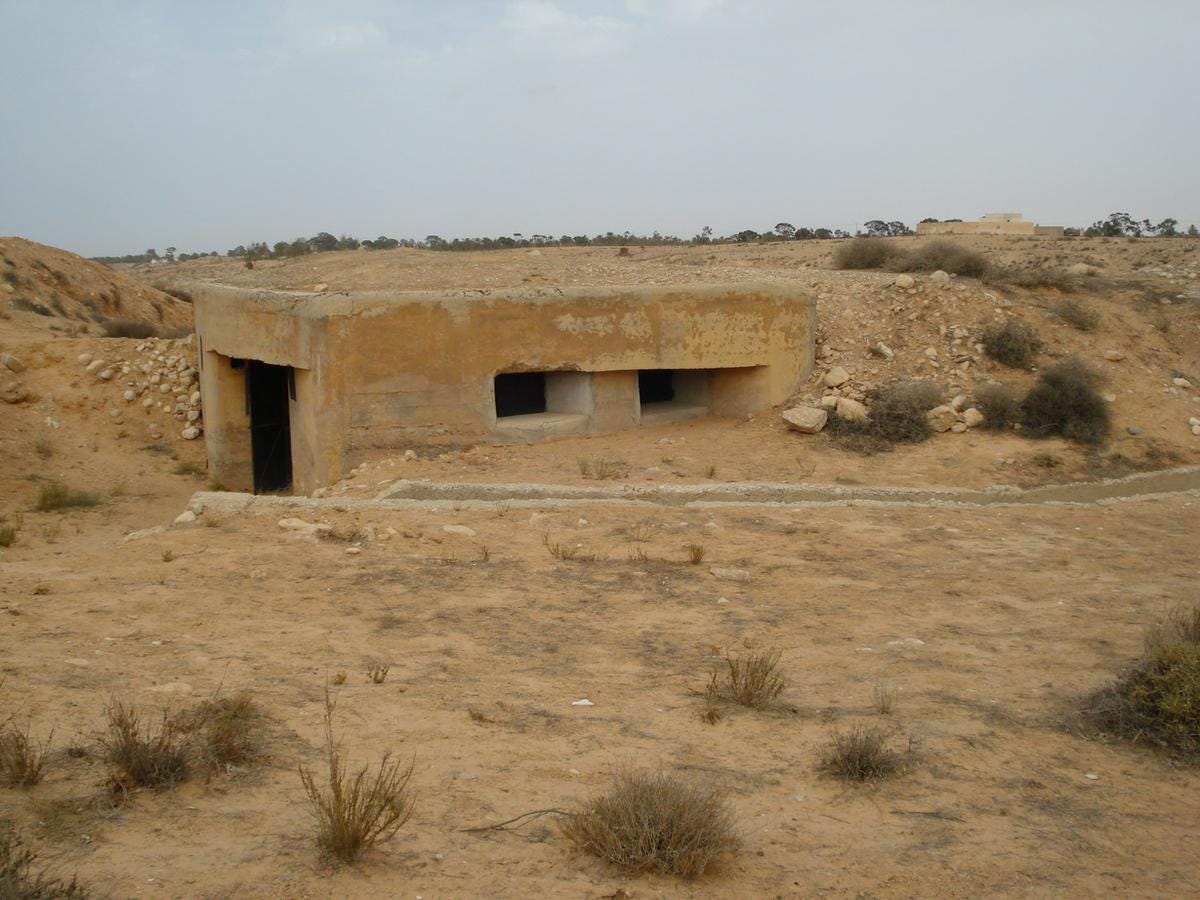
If you've been to the Normandy invasion beaches and seen the ruins of the extensive fortifications Rommel built, the Mareth Line will look familiar, except that the sand-colored desert background is much different from the green meadows of the Norman coastline. This is an infantry bunker.
Very informative. Details that I never heard before.