


This Day in World War II. April 10, 1941.
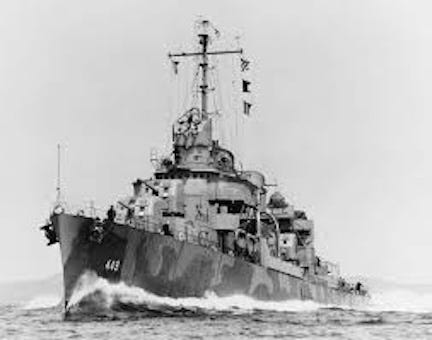
North Atlantic. Water temperature: 35 degrees.
The USS Niblack was already stopped, pulling survivors from the sea. A Dutch merchant ship, the Svenor, had gone down — another casualty of the U-boat war strangling Britain’s Atlantic lifeline. The rescue was nearly complete when the sonar operator picked up something below the surface. A contact. Moving. Closing.
Commander Edward Durgin didn’t radio Washington. There was no time, and in any case, Washington would have had nothing useful to say. He ordered three depth charges rolled off the stern.
The explosions thundered through the black water. The contact disappeared. No confirmed kill — the U-boat likely ran — but the message was delivered in the only language that mattered at that depth.
Eight months before Pearl Harbor, the United States Navy had fired on a German vessel. There was no press conference. No declaration. The Roosevelt administration said nothing, because saying something would have forced a conversation the country wasn’t ready to have.
Franklin Roosevelt understood something that drove his isolationist critics mad: timing is everything.
By the spring of 1941, he had already made his move. The Lend-Lease Act, signed just weeks earlier on March 11, had committed American industrial production to Britain’s survival — weapons, ships, food, fuel, all of it flowing across an ocean that German submarines were working around the clock to close. Roosevelt called America “the arsenal of democracy.” Germany understood what that meant, even if the American public preferred not to think about the implications.
What the public also didn’t know — couldn’t know — was that the US Navy was already quietly escorting those convoys partway across the Atlantic. American destroyers like Niblack weren’t simply on patrol. They were in the fight. Officially, they were neutral. Practically, they were picking sides one depth charge at a time.
Hitler, for his part, was playing a careful game of his own. His standing orders to U-boat commanders were explicit: do not provoke the Americans. He was fighting a two-front war and didn’t want a third. So when Niblack’s depth charges went into the water, both governments had powerful reasons to keep quiet about it. The incident vanished into the official silence that surrounds events nobody is prepared to explain.
The silence suited Roosevelt’s strategy perfectly.
To understand why, you have to understand the wall he was navigating around. The America First Committee had 800,000 members. Charles Lindbergh — still a genuine American hero to millions — was filling auditoriums arguing that Britain’s war was not America’s war, and that “the British, the Jewish, and the Roosevelt administration” were conspiring to drag the country into a conflict it had no business fighting. Father Coughlin, the “radio priest,” commanded an audience of millions with a weekly broadcast that blended populist grievance with thinly veiled sympathy for European fascism. As recently as February 1939, Fritz Kuhn’s German-American Bund had filled Madison Square Garden — swastika banners, portraits of George Washington alongside Adolf Hitler, twenty thousand people on their feet.
Kuhn was in prison by 1941, convicted on embezzlement charges. The Bund was fading. But the isolationist instinct it fed was very much alive, and Roosevelt knew that a president who appeared to be maneuvering America into war against public will was a president who would lose the argument — and possibly the next election.
So he moved carefully. Lend-Lease. Quiet convoy escorts. Rules of engagement that gave commanders like Durgin room to act. Each step was small enough that no single one forced a national reckoning. Taken together, they moved the country inches closer to the inevitable, one sonar contact at a time.
Across the Atlantic, the British were watching all of it with barely concealed anxiety. Churchill had staked Britain’s survival on the bet that America would eventually come in. He cultivated Roosevelt with the devotion of a man who knew he had no other option. Even the more cautious voices in the British establishment — men like Lord Halifax, Churchill’s former rival for Prime Minister, now serving as Ambassador in Washington — had come to understand that American hesitation was not neutrality. It was a clock running down.
The convoys Niblack was protecting were not an abstraction.
They were the oxygen keeping Britain alive — and, though Paris didn’t know it yet, keeping alive the possibility that France might one day be France again. By April 1941, Vichy had settled into collaboration, French North Africa was under Nazi-friendly control, and the Resistance was still finding its feet. The Atlantic lifeline was the thread that connected all of it: if the convoys failed, if Britain fell, the question of whether America ever entered the war became irrelevant. There would be nothing left to enter on the side of.
Commander Durgin’s depth charges went down for all of it. He just didn’t have the luxury of thinking about any of that. He had survivors in the water and a contact on his sonar.
He did his job.
The Niblack incident asks a question that keeps returning, in different forms, in different eras.
At what point does a nation committed to staying out of a war become a nation that is already in one? Roosevelt’s answer was: slowly, carefully, and without making a speech about it. He was buying time — for American industry to retool, for public opinion to shift, for events to do the work that arguments couldn’t.
Eight months later, the Japanese answered the question for him.
But on April 10, 1941, in 35-degree water north of Iceland, the first answer came from a destroyer captain who didn’t wait for orders that weren’t coming.
The depth charges sank into the dark.
The clock had already started.
The Man Who Didn’t Wait
Commander Edward Durgin faced a decision that no rulebook had anticipated. His orders didn’t authorize offensive action. But survivors were in the water, a contact was closing, and he had weapons. Durgin acted on training, instinct, and the oldest logic in naval warfare: you don’t wait to be hit first when you don’t have to. He was never formally reprimanded. He was also never publicly celebrated. Some decisions are too inconvenient to punish, and too sensitive to praise.
Brought to you by the Eddie Grant Saga
The gap between official policy and what actually happens in the field — that’s territory Eddie Grant knows well. He just usually operates a few fathoms deeper than Commander Durgin.
Eddie Grant navigates that same shadow world in Treasure of Saint-Lazare — available on Amazon.
Top-rated historical mystery of its year — Readers’ Favorite. See the entire series.
— John Pearce | Part-Time Parisian