


This Day in WWII | Tuesday, May 5, 2026 | Part-Time Parisian
The morning of April 28, 1945, is cold and grey on Lake Como. A black Alfa Romeo pulls up to the iron gate of a villa at Giulino di Mezzegra, a hamlet so small it barely registers on maps of the lake district. Two men climb out. One of them is Walter Audisio, a Communist partisan who calls himself Colonel Valerio. The other is Benito Mussolini, founder of Fascism, former dictator of Italy, once the most powerful man in Europe outside Adolf Hitler.
Mussolini is wearing a German greatcoat. He is shaking.
Audisio raises a submachine gun. It misfires. He grabs a pistol from his companion. At 4:10 in the afternoon, he fires five shots. Mussolini crumples against the gate. The man who for twenty years had ordered others shot is dead at sixty-one, in a borrowed coat, at a gate that isn’t his, in a village he has never visited before.
How does a man who once stood on balconies above a million cheering Romans end up here?
The story begins not with violence but with a vacuum. Italy in 1919 is a country that has won the war and lost the peace. Half a million Italians are dead. The promised territorial gains — Dalmatia, parts of the old Ottoman Empire — have not materialized. Veterans are angry. The economy is a wreck. The established parties have no answers.
Into this vacuum steps Benito Mussolini, a former socialist newspaper editor who has reinvented himself as a nationalist agitator. He is charismatic, physically imposing, and utterly without scruple. His Blackshirts beat strikers, burned union halls, and terrorized political opponents. Industrialists and landowners wrote the checks. The King looked away.
On October 28, 1922, Mussolini’s followers marched on Rome. Rather than order the army to disperse them, King Victor Emmanuel III handed Mussolini the government. He was thirty-nine years old. Within three years he had abolished opposition parties, gagged the press, and declared himself Il Duce — The Leader. Italy’s brief experiment in democracy was finished.
For a time, it worked. The trains ran, or so the story went. The economy stabilized. Mussolini appeared on the covers of Time and the Illustrated London News. Winston Churchill called him, in 1927, “the greatest living legislator.” The establishment across Europe saw him as a bulwark against Communism and decided not to look too hard at the price.
The price was Hitler.
In 1934, when the Austrian Nazis attempted a coup and assassinated Chancellor Engelbert Dollfuss, Mussolini moved Italian troops to the Brenner Pass and the putsch collapsed. He had blocked Hitler’s first move into Austria himself.
Two years later, everything had shifted. The two men signed the Rome-Berlin Axis in 1936. In 1938, Hitler annexed Austria without consulting his partner. Mussolini swallowed the humiliation. In 1939, he signed the Pact of Steel — a full military alliance — even though he privately told his son-in-law, Foreign Minister Galeazzo Ciano, that Italy was not ready for a major war and wouldn’t be for years. The signature went on the paper anyway.
On June 10, 1940, with France already falling, Mussolini declared war. Churchill called it a stab in the back of a man already down. Mussolini called it his chance to sit at the victors’ table. He was wrong about nearly everything that followed. His invasion of Greece without Hitler’s knowledge turned into a disaster requiring German rescue. His North African campaign collapsed. By the summer of 1943 the Allies had landed in Sicily and the Fascist Grand Council — men who had built their careers under Mussolini — voted him out of power. The King had him arrested.
Hitler flew him out of captivity in a glider raid on the Gran Sasso mountain and installed him as the puppet leader of the Italian Social Republic at Salò, on Lake Garda. Mussolini was now a prisoner of the man he had helped to power. He knew it. His diaries from this period read like a man settling accounts with himself, not planning a future.
Clara Petacci was thirty-three years old and had been Mussolini’s mistress for nearly a decade. She was the daughter of a Vatican physician, educated, dark-eyed, and wholly devoted to a man who gave her little reason to be. He had a wife. He had other women. He had told her often enough that she was an inconvenience. She stayed.
When the partisan column stopped Mussolini’s convoy at Dongo on April 27, Clara was traveling separately. She was not a fugitive; she could have walked away. She demanded to be taken to wherever they were taking him. The partisans obliged.
At the Villa Belmonte the next afternoon, when Audisio came for Mussolini, Clara threw herself between them. She grabbed the barrel of the gun. A partisan pulled her away. She was shot a few seconds after he was.
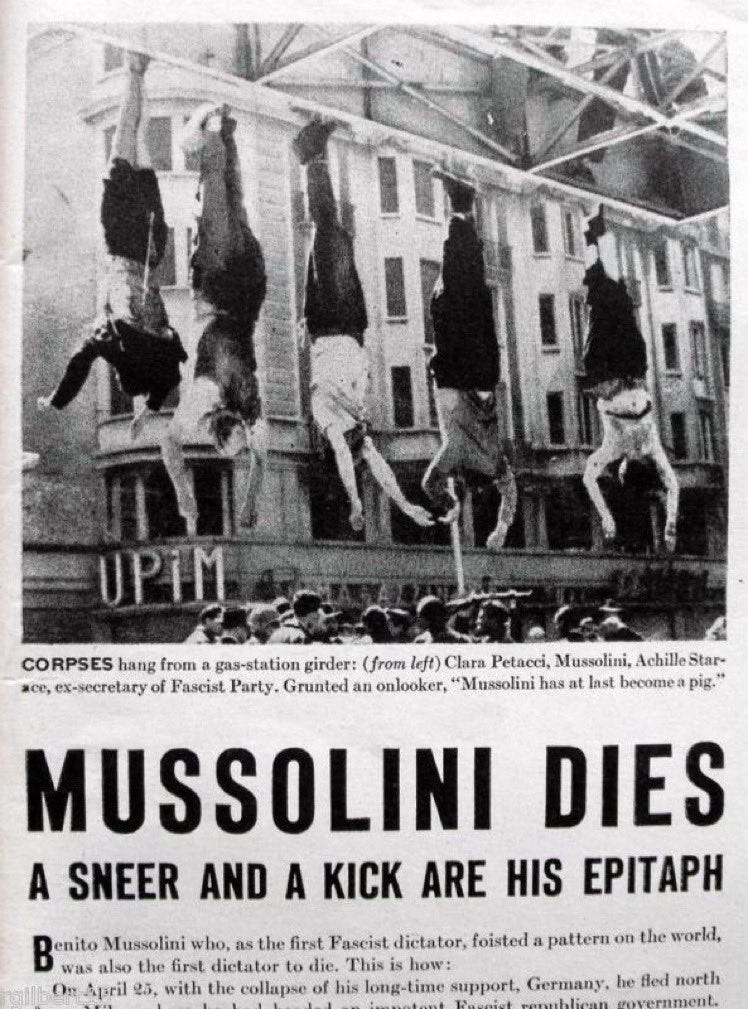
The following morning, a truck carried both bodies to Milan and hung them upside down from the roof of an Esso station in Piazzale Loreto. It was the same square where, the previous August, German troops had shot fifteen partisans and left their bodies in the street as a warning. The crowd that gathered at Loreto knew what they were seeing. Some threw stones. Some wept. A few straightened Clara’s skirt, a gesture of modesty toward the woman who had asked for nothing except not to be separated from the man she loved.
Mussolini and the French
The French had their own complicated account with Mussolini. When France fell in June 1940, he presented Hitler with a list of demands: Nice, Savoy, Corsica, Tunisia, parts of Algeria. These were territories he had coveted for years, places he described as naturally and historically Italian. Hitler refused to give them — he needed France cooperative and compliant, not humiliated by a rival. Mussolini was furious. He got almost nothing for entering a war he couldn’t afford.
What he got instead was the French Riviera. From November 1942, Italian forces occupied the southeastern corner of France — Nice, Menton, Cannes, the coast as far as the Var river. Italian officers walked the Promenade des Anglais. They requisitioned the hotels. And in one of the war’s quiet ironies, the Italian zone became a refuge. When the Germans demanded that Jewish residents be handed over for deportation, Italian officers — sometimes on their own initiative, sometimes following quiet orders from Rome — refused. Thousands of Jewish refugees were still alive in the Italian zone when Italy surrendered in September 1943 and the Germans moved in to do the work themselves.
Mussolini did not order that protection. He did not prevent it, either. His regime was brutal in its own right. But the Italian occupation of the Côte d’Azur produced, almost by accident, one of the stranger acts of decency in the history of occupied France.
Mussolini died two days before Hitler. The Axis did not end with a surrender ceremony or a signed document on a grand occasion. It ended at a gate in a village on a lake, and in a petrol station parking lot in Milan, with a crowd throwing stones at hanging bodies.
The Italian republic that came after had to be built on top of that image — and on top of the fact that millions of Italians had cheered from the crowds, right up until it stopped being safe to do so. That accounting has never been entirely finished.
What stays with me is Clara Petacci, grabbing the barrel of the gun. She knew what was happening. She had every reason to step aside. She chose not to. History doesn’t record what she said in that moment. It doesn’t need to.
If this kind of history belongs in your inbox every Tuesday, the easiest thing you can do is subscribe below. Part-Time Parisian is free, and it’s here every week.
SIDEBAR: What Happened to the Men Who Voted Him Out?
On the night of July 24–25, 1943, the Fascist Grand Council met and voted, 19 to 7, to strip Mussolini of military command. It was the first time in twenty years the body had actually voted on anything that mattered.
Mussolini did not forget.
After Hitler restored him to power at Salò, he convened a tribunal at Verona in January 1944 to try the men who had voted against him. Six were condemned and shot — including his own son-in-law, Count Galeazzo Ciano, whose diaries are among the most illuminating documents of the Fascist era and who had been warned, and chose to return to Italy anyway.
Others who had voted against Mussolini fled to Spain, Switzerland, or Allied-held territory. Several survived the war in custody. A few lived long enough to give interviews.
The Verona trials were Mussolini at his most naked: a man who had always understood power as a personal possession, responding to betrayal with the only language he had left.
Voting against a dictator, even successfully, is not always the end of your problems.
A WORD FROM THE AUTHOR
The spring of 1945 is the season Eddie Grant was made for — the moment when the old order cracks apart and the men who built it scramble for the exits. In Treasure of Saint-Lazare, Eddie moves through a Paris still sorting out who collaborated and who resisted, and finding that the line between the two is rarely where anyone expected it to be. The chaos Mussolini died in, and the quiet courage Clara Petacci showed at that gate, belong to the same moral universe Eddie navigates — one where the grand ideologies have failed and what’s left is what individual people choose to do in the moment.
Treasure of Saint-Lazare is available in Kindle, paperback, hard cover, and audio editions on Amazon. Paris Reckoning, the next installment in the Eddie Grant saga, is on its way.
— John Pearce