


This Day in WWII | The Air War Over France | Part-Time Parisian
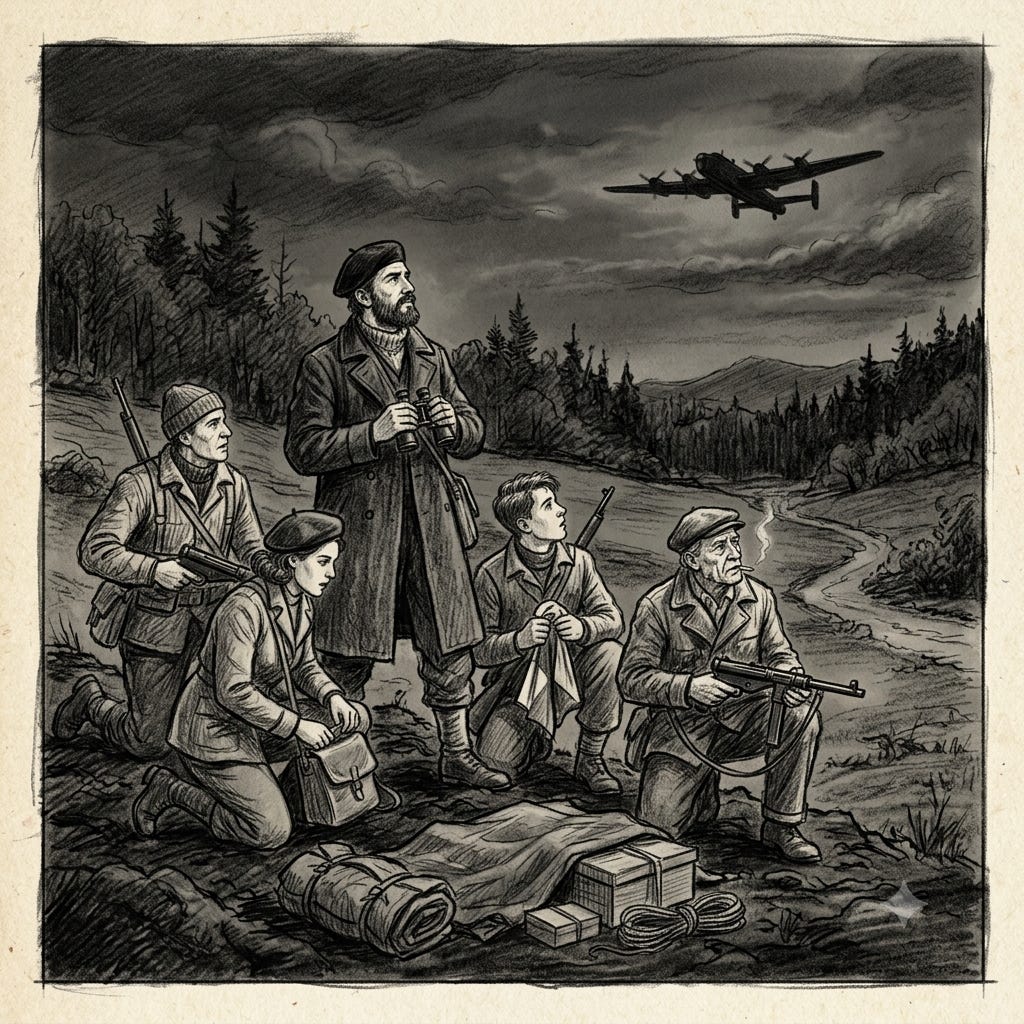
The night was moonless, which was the point.
Arthur Grant lay in the frost-stiffened grass of a plateau above Dole and listened. Somewhere to the west, a Halifax was running without lights, following a river valley at low altitude to avoid radar. He’d been told to expect it. He hadn’t been told to expect the cold.
Then he heard it — a low throb that grew into a roar, and suddenly the sky was full of parachutes, dark shapes tumbling against darker sky. Containers. Sten guns, plastic explosive, medical supplies, and if the packing list was honest, a case of Scotch whisky for the Maquis commander who had, in Artie’s professional assessment, earned it.
A girl appeared at his elbow. She couldn’t have been more than eleven. She held out a canvas bag without a word, and he understood: his job was to fill it with anything that shouldn’t be found on a dead American if the night went wrong. He handed over his OSS identity documents, his real passport, and a letter he’d been carrying too long anyway.
He had only an instant to ask her name. Margaux, she said, and vanished into the dark.
Artie Grant, of the Hudson Valley, went on to become the father of Eddie, the star of my novel series The Eddie Grant Saga. Margaux, a parisienne in training, was to be Eddie's mother, but this all happened almost ten years after the end of the war. I'll tell the whole story in the book I have planned for next year.
I was thinking ahead to that book yesterday when I came across the name of Werner Mölders, the Luftwaffe ace credited with more than 100 kills. Why the difference between the German and Allied kills? It had to do with the Nazis’ personnel planning and willingness to leave winners in the field rather than pull them out.
Why the Germans Shot Down So Many More
The question sounds simple: why did Luftwaffe aces accumulate kills at rates that dwarfed their Allied counterparts?
The answer isn’t German superiority. It’s policy, mathematics, and the brutal logic of a war fought simultaneously on two very different fronts.
The American standard of “ace” — five confirmed kills — was a threshold for recognition, not an expected career total. But the deeper difference was what happened after the kills accumulated. American pilots rotated home, typically after 25 to 50 missions depending on theater and year. The ones who survived long enough to become dangerous were pulled from combat precisely when they were most effective, reassigned to training commands where their hard-won experience could be multiplied across hundreds of new pilots.
The Luftwaffe had no equivalent policy. Erich Hartmann, who finished the war with 352 confirmed kills — the highest total in aviation history — flew over 1,400 combat missions. He didn’t rotate. He flew until Germany surrendered. The arithmetic is unforgiving: a pilot with 1,400 opportunities will outscore one with 100 every time, skill being equal.
Werner Mölders, whose 115 kills Artie’s Halifax crew would have recognized as a number to be feared, had an additional advantage: he’d sharpened his skills in Spain with the Condor Legion before the war began. He arrived at 1939 already a combat veteran, which compressed his scoring timeline dramatically. He was eventually pulled from combat himself — made Inspector of Fighters, too valuable as a symbol to risk — and died in 1941 as a passenger in a transport accident, never shot down.
The Eastern Front inflated German scores further. The volume of Soviet aircraft was enormous, and early Soviet pilot training was poor. Hartmann described many engagements as almost mechanical. Western Front scores were considerably lower, because Allied opposition was more skilled and more numerous as the war progressed.
Kill confirmation standards also differed. Allied claims required corroboration — wingman testimony, gun camera footage, crash site evidence. German claims, particularly later in the war, were sometimes accepted on a pilot’s word. The scores aren’t fraudulent, but the verification standards weren’t identical.
What It Meant on the Ground
For Artie Grant, lying in frozen grass on a Jura plateau, the ace gap was less an abstraction than a operational reality. Every supply drop depended on Allied air crews making it through. Every Lysander that landed on a clandestine strip to extract an agent, or deliver one, flew through contested airspace. The Maquis units he was assessing for Allied command were only as viable as the supply lines feeding them, and those supply lines ran through the sky.
By 1943, the Allies were winning the air war over Western Europe — slowly, at savage cost, but winning. That shift is what made the Résistance’s campaign of sabotage along the rail lines strategically meaningful rather than merely brave. The bridges Margaux’s father was blowing up in the Jura stayed down because the Germans couldn’t move freely enough to repair them before D-Day made the damage permanent.
Artie filed his assessment and moved on to the next network. He didn’t learn until after the war that the Maquis commander’s liaison — the one with the canvas bag — was the daughter of the man who would become a minister in de Gaulle’s government.
By then, she was old enough to negotiate a steel contract.
Thanks for reading
John Pearce
Washington
A mile from our cottage on the edge of our sprawling village is a memorial to the RAF and Resistence fighters who hid in nearby forests. The drops of ammo, guns and food were made in the pasture by the memorial. I knew one very old man now deceased who had hidden for years in a secret room in a barn near us. The memory of those dark days lives on across France.
Thanks for the lesson in flying ace scoring. I didn't know.