


The Bibliothèque nationale de France is sharing something lovely on its Instagram today: a behind-the-scenes look at the delicate restoration work being done on manuscripts connected to Marie de Rabutin-Chantal, Marquise de Sévigné — the woman who, arguably more than any other writer of her era, saved the texture of 17th-century Parisian life from oblivion. See their post here.
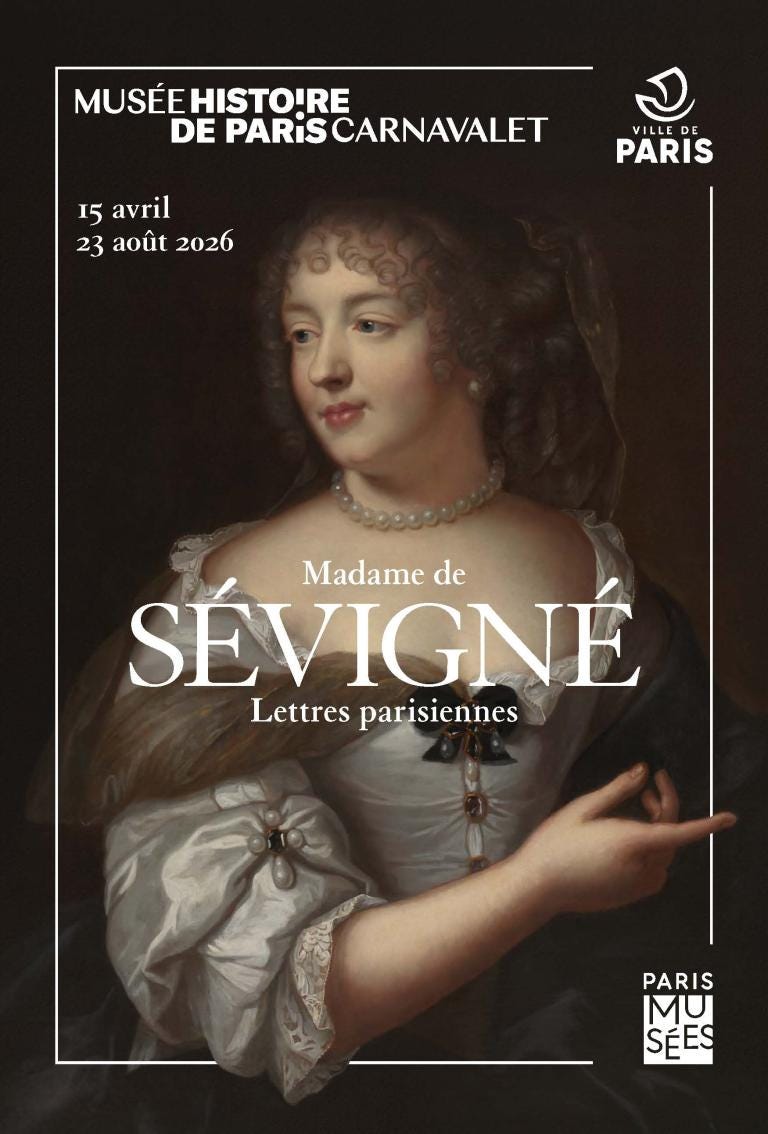
The timing is no accident. This year marks the 400th anniversary of her birth — February 5, 1626, on the Place Royale, the square we now call the Place des Vosges. And the Musée Carnavalet, in the very building where she lived her last two decades, is making it count.
The Woman Behind the Letters
Sévigné was widowed at twenty-five when her husband was killed in a duel in 1651, and she never remarried. Instead, she poured her extraordinary intelligence, her biting wit, and her bottomless affection into a correspondence that would eventually fill thousands of pages. The occasion for most of it was heartbreak of a quieter kind: in 1669, her beloved daughter Françoise-Marguerite married the Comte de Grignan and departed for Provence.
They would spend the rest of their lives apart.
What followed was one of the most sustained acts of literary love in French history. Nearly 1,372 letters are catalogued, the vast majority of them addressed to her daughter. Sévigné wrote about everything: the gossip of the court at Versailles, the trials of Nicolas Fouquet (she attended in person, horrified), military campaigns, the plague, fashions, food, the price of candles, the misery of bad roads in Brittany, and the peculiar sadness of being separated from someone you love. She moved in the most refined literary circles of the capital — the salon of the Marquise de Rambouillet, the circle of Mademoiselle de Scudéry — and she had the journalist’s eye: she couldn’t help but record what she saw.
The cruel irony is that almost none of the original manuscripts survive. What we have are copies — transcriptions made by her family and their circle, circulated, edited, and eventually published long after her death. The autograph letters that do exist are precious rarities. The BnF holds some of them, and the careful restoration work being done on these documents is a reminder of just how fragile this kind of survival is.
Lettres Parisiennes at the Carnavalet
The Musée Carnavalet — Histoire de Paris is currently mounting what may be the most important Sévigné exhibition in a generation: Madame de Sévigné: Lettres parisiennes, running through August 23, 2026.
More than 200 works — paintings, drawings, objects, manuscripts — have been assembled from the museum’s own incomparable collections, from the BnF, and from the Louvre. The exhibition crosses her literary legacy with the social and urban history of Louis XIV’s Paris, treating her letters not merely as personal documents but as what they truly are: the essential chronicle of a civilization at its most elaborate and most fragile.
The exhibition is, naturally, in the right place. Sévigné lived in the Hôtel Carnavalet from 1677 until her death in 1696. Walking those rooms is, in a real sense, walking through hers.
I never miss the Carnavalet when I’m in Paris — the permanent collection is free, and it is one of the great museums of Europe by any standard, its rooms tracing the history of Paris from Roman Lutetia through the Revolution and into the modern city. The Sévigné exhibition carries a separate ticket: €15 full price, €13 reduced. For what’s on offer, that is a genuine bargain.
Practical notes:
Open Tuesday–Sunday, 10h–17h45 (ticket windows close at 17h15)
Closed Mondays and some public holidays
Address: 23, rue Madame de Sévigné, 75003 Paris (yes, they named the street after her)
Guided visits every Saturday at 10h (book in advance)
A special reading of selected letters by Dominique Blanc of the Comédie-Française is scheduled for Sunday, June 7 at 4pm — worth planning around if you can
Sévigné died in 1696, at her daughter’s château in Grignan, having gone south at last to be near her. She had spent twenty-five years writing toward that reunion. Her letters are why we know what Paris smelled like, what people feared and laughed about, how power actually moved through the rooms of the Grand Siècle.
That the BnF is still tending these documents, still working to preserve what remains — that feels exactly right.
Thanks for reading Part-Time Parisian
John Pearce
Washington / Paris
Links:
The BnF Instagram post on the restoration work: instagram.com/p/DXuLiQhAbqN
The Carnavalet exhibition page: carnavalet.paris.fr/expositions/madame-de-sevigne