


Nancy Wake was noticeable wherever she went, whether leaving Australia with big dreams but no money or moving on to France as a freelance journalist and meeting the wealthy industrialist who became her husband and partner in espionage.
At twenty-one, she stood on a street corner in Vienna the year Hitler came to power in Germany, watched the future unfold in the most horrific way possible. She watched Nazi gangs drag Jewish men and women from shops, beating them while a crowd cheered.
She made a vow that would change the course of World War II: “I resolved then and there that if I ever had the chance, I would do anything, however big or small, stupid or dangerous, to try and make things more difficult for their rotten party.”
Eleven years later, the Nazis put a five-million-franc bounty on her head. They called her “The White Mouse” because no matter how many traps they set, she always slipped away.
From Champagne to Sabotage
Nancy Wake was never meant to be a soldier. Born in New Zealand and raised in Australia, she was a true bohemian—a nurse turned freelance journalist who loved the high life in Paris. In 1937, she met Henri Fiocca, a wealthy French industrialist. By 1939, they were married and living in a luxury apartment overlooking Marseille harbor, surrounded by champagne, caviar, and high society.
Then, Germany invaded.
While other socialites retreated into safety, Nancy leaned into the danger. She used her wealth and social status as the ultimate camouflage. While entertaining guests with expensive wine, she was secretly operating as a courier for the Pat O’Leary escape network. She used her husband’s money to buy an ambulance to smuggle downed RAF pilots and Jewish refugees across the border.
She was a master of the “hidden in plain sight” strategy. Her beauty wasn’t just an asset; it was a weapon. The Gestapo tapped her phones and watched her every move, but they couldn’t believe this sophisticated socialite was the mastermind they were looking for.
The Price of Freedom
By 1942, the “White Mouse” toppeds the Gestapo’s most-wanted list. The net was closing. The Resistance ordered her to flee to Britain. It took Nancy seven attempts to cross the Pyrenees into Spain. She jumped from moving trains, survived being shot at by German patrols, and spent nights shivering in sheep pens.
She made it. Her husband, Henri, did not.
Henri stayed behind to continue the work. He was captured and tortured by the Gestapo to betray Nancy’s location. He refused to say a word. They executed him. Nancy wouldn’t learn of his death until the war ended—a weight of guilt she carried for the rest of her life.
“Get Me Out of This Tree”
Safely in Britain, Nancy didn’t retire. She joined the Special Operations Executive (SOE). She trained in hand-to-hand combat, explosives, and silent killing. Her instructors noted she could “put the men to shame” with her marksmanship and grit.
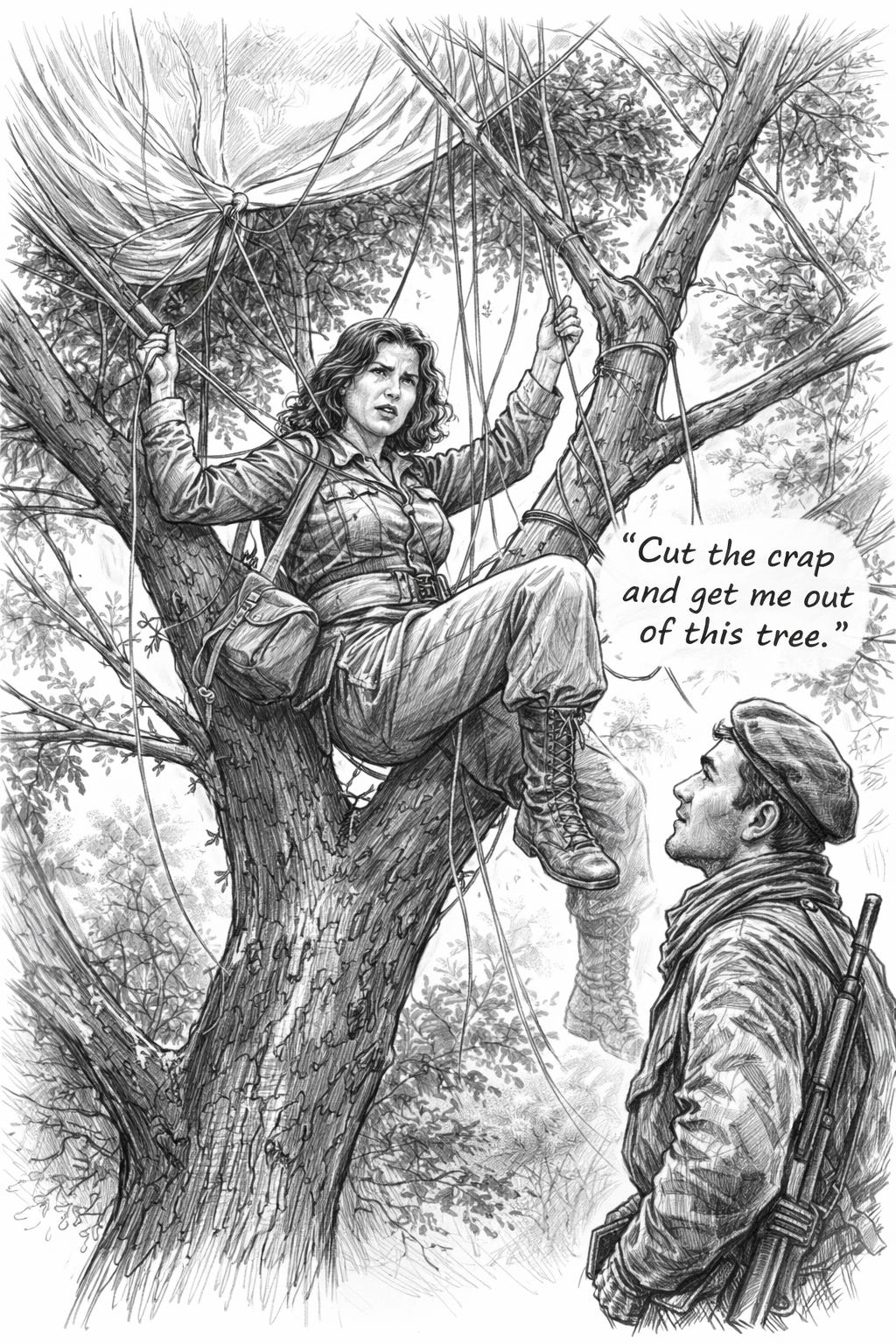
On the night of April 29, 1944, Nancy parachuted back into occupied France. She got tangled in a tree. When the French Resistance leader Henri Tardivat found her and made a flirtatious comment about beautiful women falling from the sky, Nancy snapped: “Cut out the French crap and get me out of this tree.”
She was there to lead. Assigned to oversee 7,500 Maquis fighters, Nancy transformed a scattered group of rebels into a disciplined guerrilla force. They blew up bridges, destroyed railway lines, and ambushed convoys. Under her leadership, they killed roughly 1,400 German troops while losing only 100 of their own.
The 300-Mile Bicycle Ride
Nancy’s most legendary feat wasn’t a gunfight, but a bike ride. During a German raid, her team’s radio codes were destroyed. Without them, they couldn’t request the weapons and supplies needed for D-Day.
Nancy volunteered to reach the nearest radio operator. She pedaled through German-occupied territory, passing through checkpoints by pretending to be a simple housewife out for a shopping trip. She kept her clothes neat and her makeup perfect. When stopped, she’d flirt or act indignant, and the guards—blinded by their own prejudices about what a “saboteur” looked like—let her through.
She cycled 310 miles in 72 hours. When she finally returned, she couldn’t walk or stand. She simply sat down and cried from sheer exhaustion. But she had saved the mission.
A Legacy in the Hills
Nancy Wake survived the war as the most decorated servicewoman of the Allies. She was awarded the George Medal, the Medal of Freedom, and the Croix de Guerre (three times), plus the Legion of Honor.
In her later years, she was as feisty as ever. Living at the Stafford Hotel in London, she was famous for her morning gin and tonics and her refusal to treat her medals as sacred relics. She sold them to fund her lifestyle, famously saying, “I’ll probably go to hell and they’d melt anyway.”
When she died in 2011 at the age of ninety-eight, her final wish was for her ashes to be scattered over the hills of Montluçon, where she had fought alongside her “brave men.”
The White Mouse didn’t just escape the traps; she tore them apart. She reminds us that “doing something, however big or small,” can eventually bring down an empire.
Secret Heroes is brought to you by
Great reporting on a fascinating subject and character. You really ought to write a biography of her or perhaps a novelized version of her war years (though her entire life was amazing).