


Great events bring great upheaval. When the Nazi government subjugated Poland and then France it left no room for doubt in the Western democracies—Hitler’s designs on them were plain to see. After all, his treatment of his own side on Kristallnacht was a clear sign of what he was willing to do.
The British were the first to respond, with the establishment of its Special Operations Executive. Between 1940 and 1945 SOE sent 1,800 agents into France. Women were a vanishing minority—only 93 went across the Channel, and of those 13 died, most in the concentration camps. Spying was a man's world.
In last week’s introduction to this series on the secret (and sometimes unknown) Allied heroes of World War II, we wrote about the remarkable life of Virginia Hall—the Baltimore socialite with a burning desire to be a diplomat but was foiled by the casual prejudices of the 20s and 30s, and by a rule excluding anyone with a disability from active field work. She had a wooden leg.
Instead, she took responsible clerical jobs in two European embassies and turned a tragic hunting accident into a masterclass in espionage. While her journey over the frozen Pyrenees with a prosthetic leg named “Cuthbert” is the stuff of legend, it was her time in the city of Lyon between 1941 and 1942 that truly defined her as the “most dangerous of all Allied spies”.
If the first rule of espionage is “not being seen,” Virginia Hall’s second rule was “being useful.” While the Gestapo hunted for a phantom, Hall was busy building the very infrastructure of the French Resistance.
The Legend
When she arrived in Lyon in 1941, the United States had not yet entered the war, so as a neutral she could work openly in Vichy. As a secret agent for SOE, the British Special Operations Executive, she couldn't simply announce to all and sundry that the new arrival was a spy. She needed a “legend” — the inside-baseball term for a cover story.
She found her legend at the New York Post. By filing legitimate stories on the hardships of life in Vichy France, she created a cover that allowed her to move through society unchallenged, at least at first. Through a back channel, she sent pure intelligence reports.
To the Vichy authorities, she was a diligent American reporter. To the SOE in London, she was “Marie,” their primary eyes and ears in the south. She exploited the “blind spot” that many men in power had regarding women: they assumed she was apolitical and harmless. They couldn’t have been more wrong.
Building the HECKLER Network
Hall’s true work was clerical, logistical, and lethal. First in Vichy, then in Lyon, she established the HECKLER network, a web of safe houses and informants that became the gold standard for underground operations. She didn’t just recruit soldiers; she recruited people who had a reason to be where the Germans were.
She famously enlisted a local gynecologist, Dr. Jean Rousset, who used his clinic to hide agents and treat wounded resistance fighters. She even brought a brothel owner into the fold, using pillow talk to coax nuggets of intelligence from indiscreet German officers at a time when their guard was down. She was no James Bond figure, but a determined operative working through the grueling and dangerous work of organizing resistance cells, coordinating escape lines for downed Allied airmen, and transmitting intelligence under the constant threat of radio-direction hunters.
The Mauzac Breakout
Perhaps the greatest testament to Hall’s organizational genius was the 1942 escape from Mauzac prison. When eleven of her fellow agents were captured and interned, Hall didn’t stage a frontal assault. Instead, she used her network to smuggle tools, a radio, and even a key fashioned from a sardine tin into the prison.
She coordinated the logistics from the outside, ensuring that once the men climbed the walls, they had a “pathway” of safe houses and transport waiting to whisk them toward the Spanish border. It was a feat of coordination that humiliated the Gestapo and cemented her reputation in London.
The Limping Lady Vanishes
By late 1942, the “polite fiction” of an independent Vichy zone ended as the Germans moved to occupy the south. Hall’s name began appearing in German reports. The Gestapo knew there was a woman with a limp—La Femme Qui Boite—pulling the strings, and they wanted her dead.
As the net tightened, Hall performed the ultimate act of an underground operator: she vanished. Her escape over the Pyrenees was not a “heroic dash” but a slow, agonizing trek through the snow where her prosthetic leg froze repeatedly. Yet, she reached Spain alive.
The Return of “Diane”
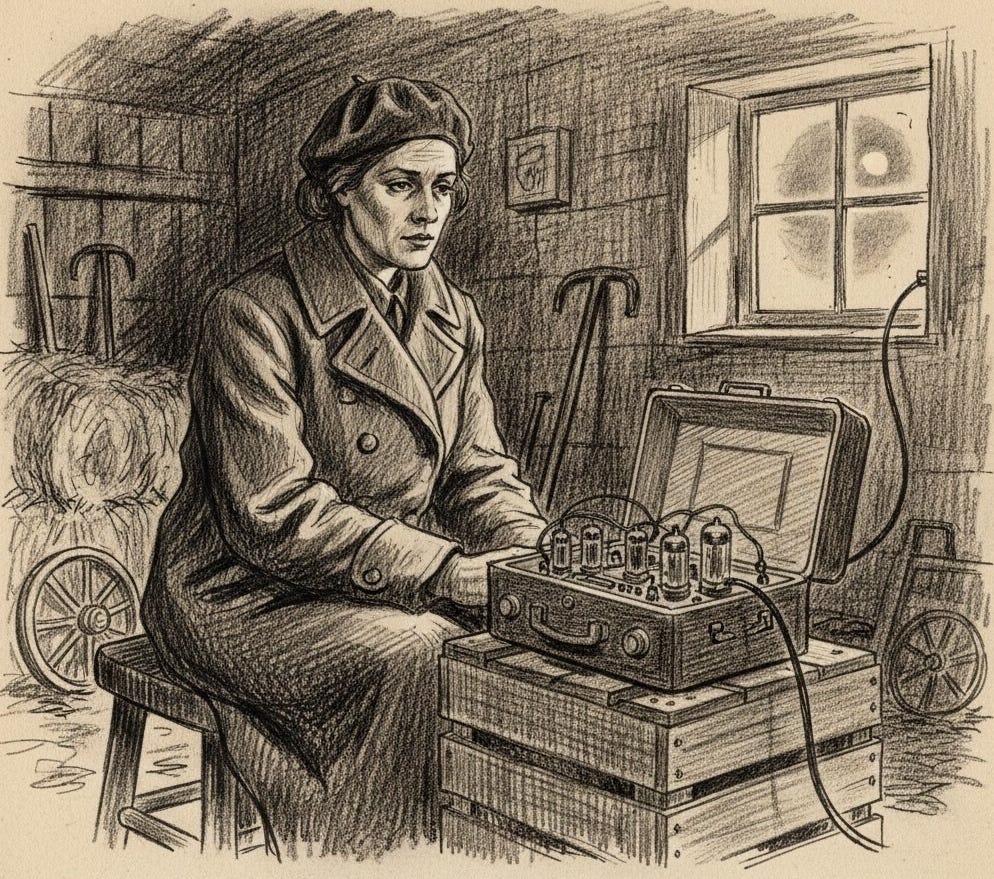
Most would have retired after such an ordeal, but Hall’s war was only half over. After the U.S. entered the conflict, she joined the Office of Strategic Services (OSS) and demanded to return to France. This was the tense time before the Normandy invasion, and she played a key role in the Resistance's main job, which was preventing German troops from reinforcing the Normandy beaches and harassing the ones away from the beach as best she could. This meant blowing up rail bridges.
Disguised as an elderly peasant woman—shuffling her feet to hide her limp—she returned in 1944 under the codename “Diane.” This time, her role was even more direct. She moved from Lyon to the Haute-Loire region to live as a peasant farmer while she armed and trained three battalions of Resistance fighters. By the time Allied troops arrived, her units had sabotaged dozens of bridges and rail lines, effectively paralyzing German reinforcements.
Within weeks of D-Day, as American forces pushed inland from Normandy, Virginia Hall finally met U.S. soldiers on French soil — men who advanced with maps and artillery, guided in part by networks she had built years earlier in silence.
Le Chambon-sur-Lignon — Village of Silence Virginia Hall’s choice for her 1944 operational base was the secluded, mountainous village of Le Chambon-sur-Lignon. Located on the Lignon Plateau in the Haute-Loire, the village offered a unique environment that allowed her to manage a resistance network in relative secrecy.
Huguenot History: For centuries, this Protestant community had a tradition of resistance. Having faced persecution by the French Crown in the past, they possessed a cultural memory of defiance and secrecy that proved catastrophic for the Nazi occupiers.
Network of Compassion: Led by Pastor André Trocmé, the community established a vast network that hid thousands of Jewish refugees and Allied airmen.
A “Conspiracy of Silence”: The entire village shared a silent pact to protect those in hiding. Many homes had secret compartments—originally used to hide pastors during religious wars—which Hall used to conceal her radio equipment.A Legacy of resistance
Virginia Hall’s work was fought in rented rooms and borrowed identities. When peace came, she didn’t seek the spotlight. She didn’t write memoirs or give interviews. She served quietly in the CIA during the Cold War and retired to a farm in Maryland.
She matters today because she reminds us that the most effective heroes are often the ones who are never noticed until it is far too late for the enemy to stop them.
The Attack on the Pont de Chamalières
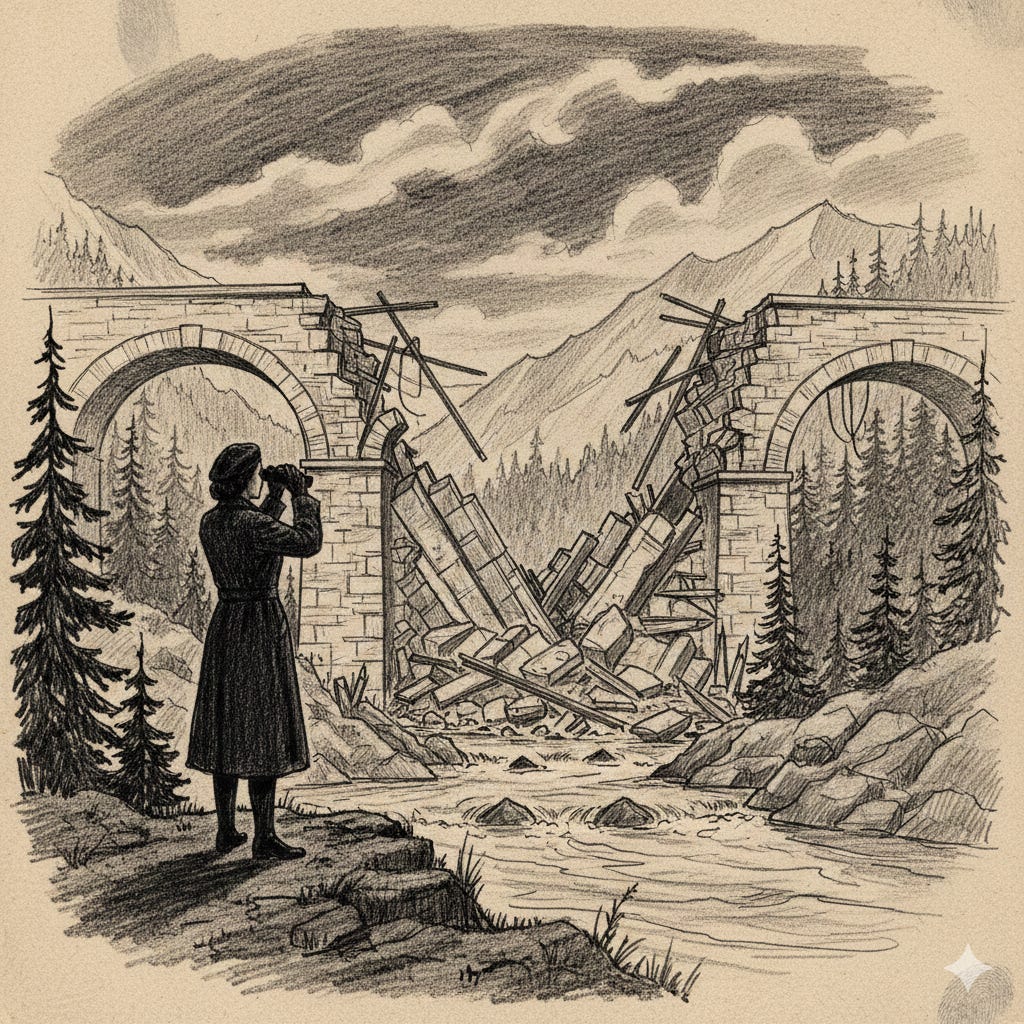
People who live the secret life are remembered, if at all, by the high points of their lives. For Virginia Hall, alias Diane, one of those was the attack on the Pont de Chamalières, a major railway crossing near Le Puy.
The one-track bridge was a strategic bottleneck for the German 19th Army. By August 1944, Hall’s “Saint” circuit had paralyzed the region’s infrastructure. Her role in this specific attack was that of the architect:
The Intelligence: Hall scouted the bridge’s defenses while in her “peasant” disguise, noting the frequency of German patrols.
The Logistics: She coordinated the parachute drops of explosives and detonators needed to take down stone masonry.
The Command: While her maquis fighters placed the charges, Hall remained the commanding officer of the operation, ensuring the bridge fell exactly when it would cause the most chaos for retreating German columns. Then her men drove a locomotive into the gap at high speed, insuring the line could not be repaired quickly.
Links
The CIA's own account of Virginia Hall's service.
Hall's official account of her work in France, written after she left, dated September 1944.
Remarkable Women: The Life and Times of Virginia Hall (Rhapsody in Words)
The Distinguished Service Cross
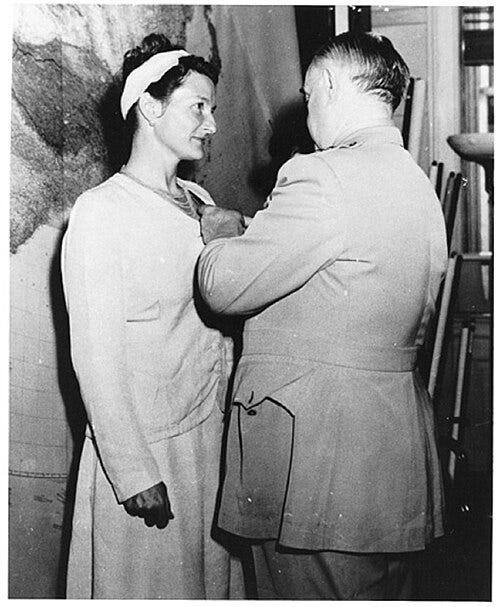
Virginia Hall was the only American Woman to receive the Distinguished Service Cross for World War II. She turned down the chance to receive it from President Truman personally, saying she had work to do (or so the story goes). This photo is the official CIA record of its award by OSS chief Gen. William Donovan.
Brought to you by The Eddie Grant Saga
