


In the spring of 1944, Britain faced a quiet crisis.
Allied planners were preparing the Normandy landings, but intelligence from the region was collapsing. German counter-espionage had grown brutally efficient. Radio operators, who had a lifespan measured in weeks, disappeared. Couriers were captured. Entire resistance networks went silent.
By May, Britain’s Special Operations Executive made an extraordinary decision. If trained men could no longer survive behind enemy lines in Normandy, they would send someone the Germans would not look for at all.
Her name was Phyllis Latour. She went by Pippa.
At a very young 23 years old she volunteered, knowing that agents sent before her into the region had been captured. Her cover would not be that of a professional operative—or even an adult—but a desperately poor French girl, scarcely more than a child.
On the night of May 1, 1944, she stood in the open door of a British bomber and jumped into occupied France. She buried her parachute, her uniform, and her real identity. Then she became someone else entirely.
For the next four months, Pippa moved through Nazi-occupied Normandy on a battered bicycle, a basket of soap bars hanging from the handlebars. On paper, she was a harmless peasant girl selling household goods from farm to farm. In reality, every journey was a reconnaissance mission.
She passed through German checkpoints almost daily. She chatted with soldiers, giggled nervously, asked foolish questions about their uniforms and their homes in Germany. The act was deliberate. She played the role of a girl too naïve, too uneducated, too insignificant to be dangerous.
While they dismissed her, she memorized everything: unit insignia, troop movements, fortification sites, supply routes, radio traffic patterns.
At night, she disappeared into the countryside. She assembled her wireless set in forests, barns, abandoned buildings—never transmitting from the same place twice. German mobile detection units could triangulate radio signals within minutes. Survival meant constant movement.
Her codes were written on silk: light, silent, and easy to conceal. After each transmission, she marked the code with a pinprick so she would never reuse it, then rolled the silk, used a knitting needle to push it into a flat shoelace, and used it to tie up her hair.
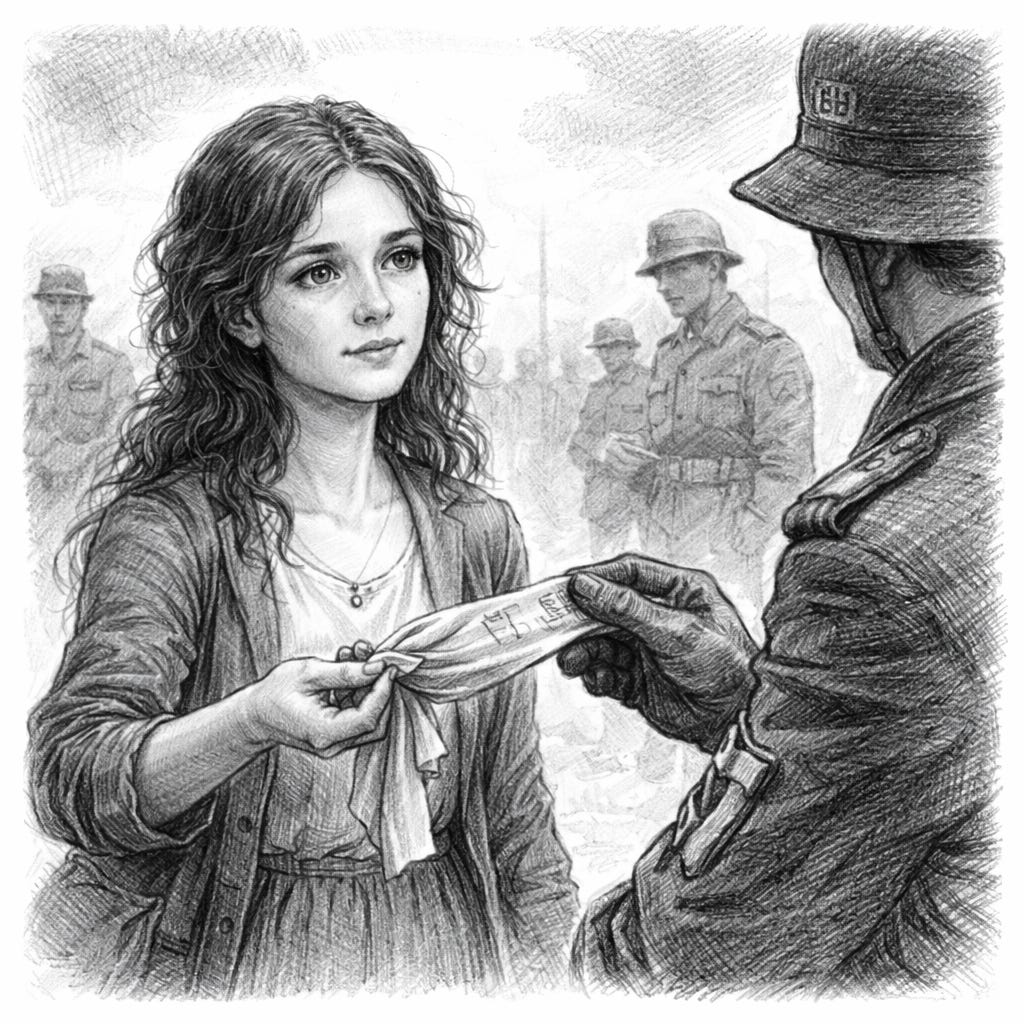
One afternoon, German soldiers stopped her at a checkpoint. There had been reports of partisan activity nearby. They searched her bicycle, her basket, her clothes, the soap bars. Nothing.
When one soldier pointed to her hair she didn’t hesitate. She untied the shoelace and handed it to him with an innocent smile.
Inside that ribbon was silk containing every code she'd used—enough to have her tortured and executed, but the soldier looked at it only briefly and handed it back.
For four months, Pippa lived this way. She slept outdoors, scavenged food, and never stayed anywhere long enough to feel safe. By D-Day, she had transmitted 135 coded messages to London—more than any other female SOE agent operating in France.
Those messages helped Allied planners understand what waited beyond the beaches: where German units were concentrated, which fortifications were active, how supplies moved inland. They guided bombing raids and reduced uncertainty at the most dangerous moment of the war.
On August 25, 1944, Paris was liberated. Latour’s mission was over.
She married Doyle, an engineer, to New Zealand, and raised four children. For more than half a century, she told them almost nothing about what she had done. Her wartime service remained unspoken, locked away with the same discipline that had kept her alive in Normandy.
In 2000, her eldest son discovered her story online while researching women of the SOE. When he asked her about it, she confirmed it quietly. Yes, she had been a spy. Yes, she had done those things. It was simply what needed to be done.
France formally honored her in 2014 with the Chevalier de la Légion d’Honneur. She accepted it without ceremony.
Phyllis Latour-Doyle died on October 7, 2023, at the age of 102.
She outlived the regime that tried to destroy her by nearly eight decades. The free world inherited after D-Day exists, in part, because a young woman rode a bicycle through Nazi checkpoints, hid her secrets in her hair, and was never suspected at all.
New here?
Start with Lauren, the story of Eddie Grant, the former Special Forces commander turned billionaire Paris businessman. Eddie met Lauren Adams at college in West Texas. She would become his first wife and live with him in Paris until her death—the origin of the story behind Treasure of Saint-Lazare. My short story Lauren is just the thing for Paris lovers, and it's a free download.
Sidebar: Why Phyllis Latour Mattered
By early 1944, the Germans had become exceptionally skilled at dismantling resistance networks in Normandy. Male operatives—often young, fit, and carrying suspicious equipment—stood out. Many were captured within weeks.
Pippa Latour’s value was not just bravery, but invisibility.
Her disguise exploited assumptions the occupiers rarely questioned: that a poor teenage girl was harmless, unintelligent, and beneath notice. It allowed her to move constantly, gather intelligence casually, and pass through checkpoints that would have been deadly for others.
Her reports helped reduce uncertainty in the final days before D-Day—when uncertainty cost lives.
Sometimes the most effective weapon in war is not force, but being overlooked.
Links
Her posthumous autobiography was well received.
The Last Secret Agent: My Life as a Spy Behind Nazi Lines
Her Wikipedia page contains many interesting links.
An amazing and moving story, John, and very well told. Bravo 👏. Makes my mom's wartime resistance activities sound like a cake-walk. I'm glad neither one of them lived to see America go Nazi Fascist under Trump. Keep up the great work. Thanks 👍