


This Day in WWII | Tuesday, April 21, 2026 | Part-Time Parisian
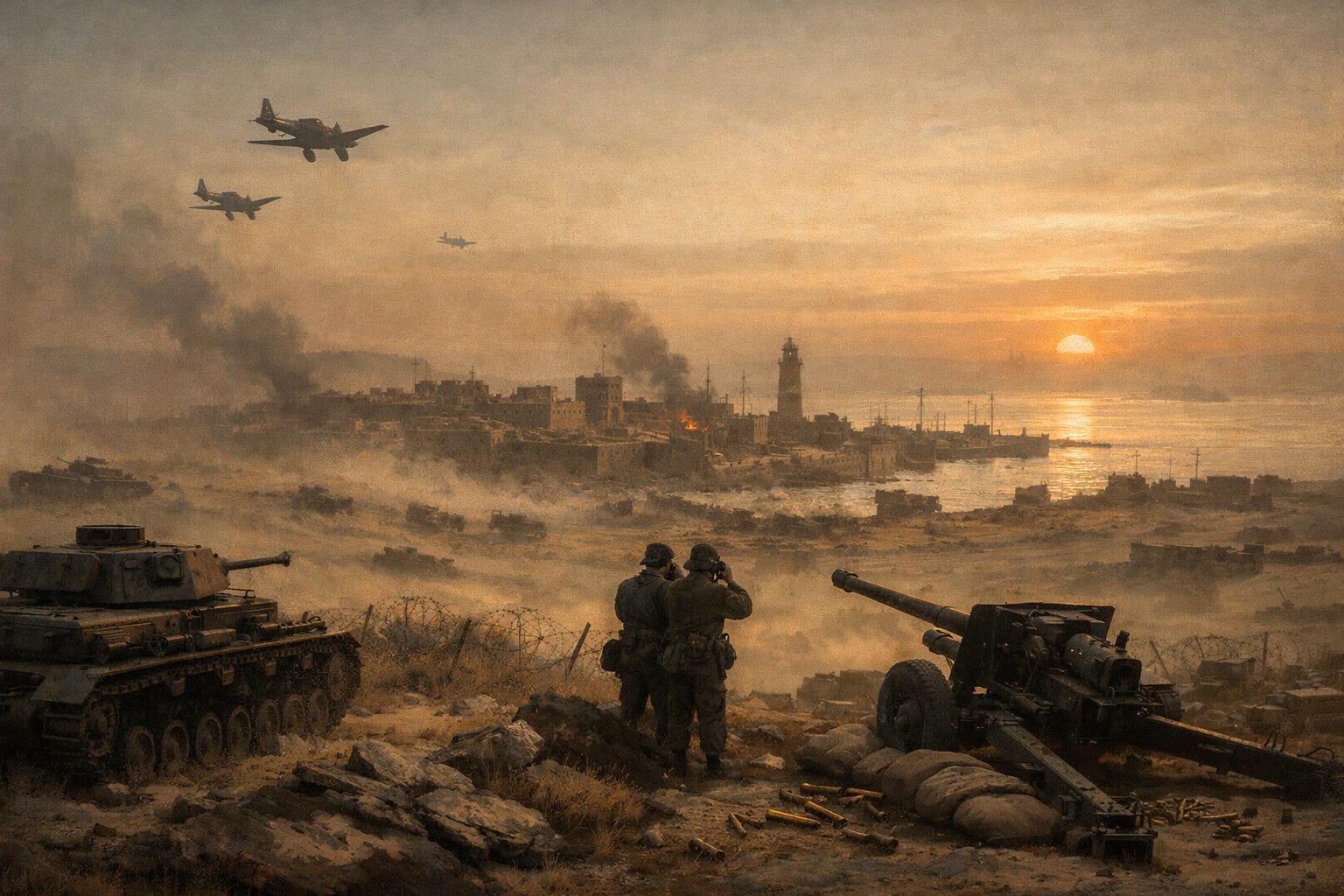
Rommel ordered his first assault on Tobruk on April 13, 1941. He expected it to fall within days.
It would not fall for 241.
In the spring of that year, he was a man who had stopped believing anything was impossible. He had driven across France in six weeks. He had arrived in North Africa in February with a handful of German units and, inside of two months, had reversed the entire trajectory of the Western Desert war — pushing the British back across Libya, all the way to the Egyptian border, in a campaign that left his own high command struggling to keep up with him.
By mid-April he had nearly everything he wanted. Nearly.
Behind his lines, on the Libyan coast, sat a port he needed badly. His supply lines ran more than a thousand miles back to Tripoli, and every mile of that road was a vulnerability. A functioning port this far forward would change his logistics entirely.
The garrison holding Tobruk was built around the 9th Australian Division, reinforced by Free French, Polish, and British units — roughly 35,000 men in all. They were dug in behind a ring of concrete fortifications the Italians had built before the war, and their commander, General Leslie Morshead, made clear from the start that defense meant attack. When the Afrika Korps probed, the Australians counterattacked. When German armor found a gap, infantry closed it. Morshead had no intention of presiding over another Dunkirk — if they had to fight their way out, they would fight their way out.
Rommel threw his best units at the perimeter through April and into May — coordinated armor and infantry assaults, air raids, artillery that never really stopped. The defenders held. By summer the siege had settled into something grimmer than battle: heat that cracked lips and split skin, flies that swarmed every meal, dust that found its way into everything. Water was rationed. Mail was irregular. The harbor was bombed almost daily.
Axis radio, broadcasting in English, began calling them the Rats of Tobruk — burrowing in tunnels and dugouts, too beaten to fight in the open. The garrison adopted the name within the week. They wore it like a medal.
Every week, Part-Time Parisian brings you history like this — the stories that didn’t make the textbooks, with the French angle most writers miss. If this is your first time here, subscribe below. It’s free.
What kept them alive, beyond their own stubbornness, was the Royal Navy. Because Rommel controlled every land approach, the only way to supply Tobruk was by sea — at night, under air and submarine attack, destroyers and smaller vessels threading into the harbor after dark to unload ammunition, food, water, and medical supplies before dawn. The sailors called it the Spud Run. The men on shore called it the Tobruk Ferry Service. It ran for eight months.
The siege was finally lifted in December 1941 during Operation Crusader — one of the first clear Allied ground victories of the war, and proof, if anyone still needed it, that Rommel’s momentum was not a law of nature.
---
The Free French at Tobruk
They tend to get lost in the larger narrative, but the soldiers of the 1st Free French Brigade were part of the Tobruk garrison from the beginning of the siege. Among them were units of the Foreign Legion — men who, after the fall of France, had refused the armistice and followed de Gaulle into an army that existed almost entirely on faith and British logistics.
Tobruk was one of the first places those men actually fought — proof, in the logic de Gaulle was always trying to demonstrate, that Free France was a force and not merely a symbol. The Rats, as it happened, came in more than one language.
---
While Rommel Hammered Tobruk, Greece Was Coming Apart
The German invasion had begun on April 6, driving through Yugoslavia and Bulgaria with the speed that had by now become the Wehrmacht’s signature. The Greek army had been fighting Italy since October 1940 — five months of mountain warfare in Albania that had, improbably, pushed the Italians back. It was one of the few early bright spots of the war. The Germans ended it in days.
The British and Commonwealth forces Churchill had sent to help were overmatched from the start. By mid-April the question was no longer whether Greece could be held but how many men could be gotten out.
On April 18, the Greek prime minister, Alexandros Koryzis, shot himself. He had held the office for only three months, appointed in January after his predecessor died of a heart attack. He had done what he could. The Germans were in Thessaloniki; the line was broken; the government was preparing to flee to Crete. Whatever he believed his duty required of him, he concluded he had failed it. He was 56.
His name does not appear in most popular histories of the war. But his death marks the moment, more precisely than any military date, when Greece understood what was coming.
The British evacuation — Operation Demon — began April 24. By early May, roughly 50,000 Allied troops had been lifted off beaches in the dark, in small boats, under air attack. Thousands more were left behind. The occupation that followed was among the harshest in Western Europe: organized famine, mass reprisals, deportations. When the Germans finally withdrew in 1944, credible estimates put the civilian death toll from starvation alone as high as 300,000.
And then the civil war started.
The Guns of Navarone
If you know the Greece of this period at all, you may know it through Alistair MacLean’s *The Guns of Navarone* — the 1957 novel, or the 1961 film with Gregory Peck and David Niven, the one with the cliff climb and the guns hidden in the rock and the impossible mission threading through a German-occupied Aegean island. MacLean served in the Royal Navy during the war; the book is fiction, based on the Leros campaign of two years later, but it is fiction that understands something true about occupation — that resistance is most often improvised, terrified, and conducted by people with no good options.
The real stories are harder and stranger than the novel. The Greek resistance was fragmented and eventually turned on itself, communist and royalist factions fighting each other even as they fought the Germans. Britain backed one side, then stepped back; the United States stepped in under the Truman Doctrine. The civil war ran until 1949. It is not too much to say that the war Greece fought between 1940 and 1949 was, in some form, a single continuous catastrophe — nine years without a year of genuine peace.
For readers whose image of wartime France includes the ambiguities of occupation — collaboration, resistance, survival, and the compromises in between — Greece offers an equally layered story, less familiar and no less worth knowing.
The Tobruk Ferry Service
Rommel controlled every road between Tobruk and the Egyptian border. That meant the garrison could not be supplied overland — not a truck, not a crate of ammunition, not a liter of water. Everything had to come by sea.
The Royal Navy improvised a nightly run: destroyers, sloops, and small vessels slipping into the harbor after dark, unloading under blackout conditions, and out again before dawn. Sailors called it the Spud Run. The men ashore called it the Tobruk Ferry Service. It operated under constant threat from German aircraft and Italian submarines, and it sustained more than 35,000 defenders through eight months of siege — food, water, ammunition, replacement troops, and the wounded going out. It was one of the war’s more remarkable logistical achievements, conducted almost entirely in darkness, and it rarely gets the attention it deserves.
A Word from the Author
The soldiers of the French Foreign Legion who held Tobruk — men who had crossed the Mediterranean rather than accept an armistice they considered a betrayal — are the direct ancestors of the world Eddie Grant moves through in the Eddie Grant Saga. That refusal, that particular French stubbornness in the face of catastrophe, runs through Treasure of Saint-Lazare and into *Paris Reckoning*, which publishes in weeks. If you haven’t started the series, the door is open.
Thanks for reading Part-Time Parisian.
John Pearce
Washington / Paris