


This Day in WWII | Tuesday, July 7 | Part-Time Parisian
Night of October 15, 1941. Odessa harbor. Engines cut low, running lights dark, the last ships of the Soviet Black Sea Fleet pull away from the docks with 35,000 troops crammed below deck — the final wave of an evacuation that has already moved 121,000 people, a thousand trucks, and 20,000 tons of ammunition out of a city the Kremlin has quietly decided isn’t worth holding. Engineers wire what’s left to blow. Romanian infantry are already moving through the northern suburbs. By dawn the flag over city hall will be someone else’s.
Eighty-five years later and a few hundred miles east, the same peninsula those ships are steaming toward — Crimea — is choking on its own supply lines. Ukrainian drones have turned a 390-mile Russian truck route into what soldiers on both sides now call the “Highway of Death.” Fuel rationing. Rolling blackouts in Sevastopol. The Kerch Bridge backed up with traffic in both directions as military families try to get out.
Same coastline. Same war, in the sense that no war really ends, it just changes verbs. In 1941, Crimea was where you ran to. In 2026, it’s where the walls are closing in.
The siege
Odessa’s ordeal starts the way most of Barbarossa starts — fast, brutal, and worse than Berlin expected. Hitler hands the job to Romania’s 4th Army under Directive No. 31 in early August 1941, and Marshal Ion Antonescu, eager to reclaim Bessarabia and prove Romania’s worth to its German patron, throws his troops at the city with more enthusiasm than skill. The Black Sea Fleet becomes the reason the siege drags on as long as it does — resupplying the garrison by sea, landing reinforcements, keeping Odessa’s defenders fed and armed while the noose tightens on land.
Mid-August brings a renewed Axis push and real gains, but by August 24 the casualties are bad enough that Romanian command has to stop and regroup. Through September, the fighting grinds toward the city itself. Soviet troops fall back street by street as Romanian forces take high ground northwest of the city. And somewhere in Moscow, a harder calculation is being made: with Kyiv under direct threat and the whole southern front buckling, Odessa’s defenders — trained, equipped, blooded — are worth more somewhere else than dying in a city Stavka has already written off.
That’s what the October evacuation really is. Not a retreat. A withdrawal of assets. The same 35,000 troops who held Odessa’s line for ten weeks get shipped straight to Sevastopol, where they’ll spend the next several months holding a different line against a different siege. One doomed stand feeding directly into the next.
The cost, by the numbers: Romania loses 17,729 killed, 63,345 wounded, 11,471 missing — nearly a third of the force committed. Soviet losses run to 16,578 killed or missing and 24,690 wounded. Then the occupation begins, and the real horror starts: roughly 280,000 people, overwhelmingly Jewish, murdered or deported before Odessa is finally liberated in April 1944.
The Frenchman who built the city
Here’s the detail that makes Odessa more than a battle map: the boulevards those Romanian troops were fighting street by street, the wide grid, the whole “Paris of the Black Sea” identity the city still trades on — that’s the work of a Frenchman. The Duc de Richelieu, a nobleman who fled the guillotine and offered his sword to the Tsar instead, became Odessa’s founding governor in 1803. He laid out the streets. He built the port. His statue still stands at the top of the Potemkin Steps, arm extended toward the harbor those evacuation ships would use 138 years later. A Revolutionary émigré built the city Hitler’s allies spent the autumn of 1941 trying to take apart.
What Crimea inherited
Flip the map forward to this summer. Crimea — the place Odessa’s survivors ran to, the peninsula Stalin’s navy treated as the safe rear area — is now the thing Ukraine is trying to strangle. Ukrainian strikes have disabled S-400 and Pantsir air defense batteries near Kerch, hit oil terminals on both sides of the strait, and cut power to Sevastopol and Yevpatoria more than once this summer. Russia’s occupation government has rationed civilian fuel. The only route left onto the peninsula that still works reliably is the Kerch Bridge itself, and even that’s backed up with families trying to leave.
Putin has called Crimea his greatest strategic prize since 2014. Right now it’s starting to look like his most expensive one — a peninsula that once absorbed the overflow of a lost war and is now generating a new one, slowly, mile by burned-out mile of the Highway of Death.
Sidebar: Duc de Richelieu, in brief
Armand-Emmanuel du Plessis, Duc de Richelieu (1766–1822) — fled Revolutionary France, served in Catherine the Great’s army against the Ottomans, and was appointed Odessa’s governor by Tsar Alexander I in 1803. He built the port, the university, and the boulevard grid that still defines the city center. He returned to France in 1814 and eventually served as prime minister under Louis XVIII — a French Revolution émigré’s second act, several thousand miles and one empire away from where he started.
PARIS RECKONING is selling well on Amazon. Five days after publication, it has reached top-1,000 ranking for both military and espionage thrillers. It has twelve Goodreads reviews and an overall star ranking of 4.8 out of 5 on Amazon.
If you bought it or received an ARC, a review would be a big help to me. Indie novels live or die on reader reviews, and I have hopes this one will sell very well. I have a second and a third book planned for the Sandi Brennan Series.
Footnote:
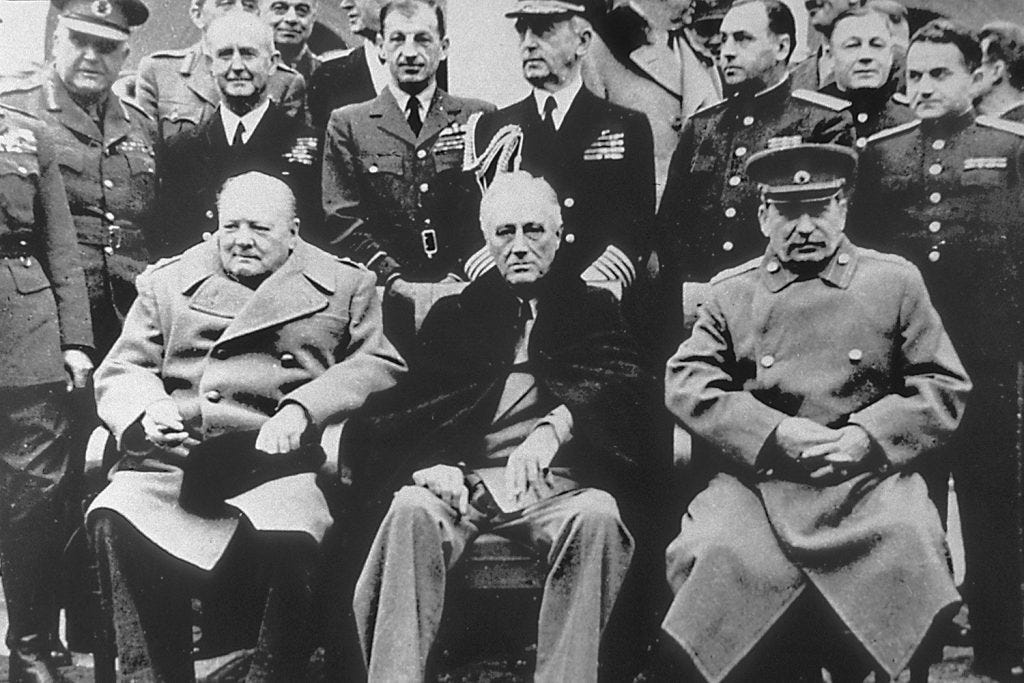
FDR, Churchill and Stalin met in Crimea for the Yalta Conference. The venue, Livadia Palace, had been left in ruins. Nevertheless, just weeks before the conference, the palace was completely transformed and fully functional by the time the Big Three arrived in February 1945.
Because the decision to hold the conference in Yalta was not finalized until mid-January 1945, the Soviet government had less than three weeks to prepare. They pulled off a massive, frantic logistical effort to make it habitable:
Stripped and Refurnished: The retreating Germans had left virtually no furniture behind (reportedly, only two pictures remained in what became President Roosevelt’s bedroom). The Soviets stripped hotels, sanatoriums, and public buildings in Moscow and other cities, transporting entire trainloads of furniture, rugs, and hardware to Crimea.
Staffed by Moscow’s Finest: Since local infrastructure was devastated, complete hotel and kitchen staffs were brought in directly from luxury hotels in Moscow to serve the delegations.
Sanitation Overhaul: Because the buildings were left heavily infested and unsanitary following the occupation, Soviet laborers and U.S. personnel (including crew members from the USS Catoctin, which was stationed nearby) worked around the clock to disinfect the palace, install modern plumbing, and ensure it was safe and comfortable.
By the start of the conference on February 4, 1945, the main Livadia Palace was comfortable enough to serve as the official residence for President Franklin D. Roosevelt and the American delegation, as well as the primary venue for the plenary sessions of the Big Three.
It was the changing of the guard. In two months FDR would be dead, and three months after that Churchill would be turned out of office. Stalin stayed in power until his death in 1953.
—John Pearce
Washington/Paris
A much-coveted peninsula and a many-times bloodied battleground, Crimea may prove to be Putin's graveyard. Good stuff, John, and kudos for the book, which is a great read.