


This Day in WWII | Tuesday, May 12 | Part-Time Parisian
The evening of May 10, 1941, seven months before Pearl Harbor, settled quietly over the Scottish lowlands near Eaglesham — farm fields, stone walls, the smell of turned earth. Then came the sound: a twin-engine aircraft low and fast, trailing flame from one engine. David McLean, a farmer, stepped outside and looked up. He watched a figure drop from the plane and a parachute blossom against the darkening sky.
McLean found the man in a Messerschmitt flight suit lying in his field, ankle broken from the landing. The stranger said his name was Hauptmann Alfred Horn, and that he had urgent business with the Duke of Hamilton.
He was lying about his name. The Duke of Hamilton had never agreed to meet him. And the business he carried — a self-authored peace proposal for the British government — had been authorized by no one in Berlin, although that would not stop generations of conspiracy fabulists.
His real name was Rudolf Hess. Deputy Führer of the Third Reich. Third in the Nazi hierarchy, behind only Hitler and Göring. And he had just flown more than 900 miles alone, in a modified Bf 110 stripped of armament and fitted with auxiliary fuel tanks, with no navigator, no return fuel, and no plan beyond landing in a Scottish field and changing the course of the war.
The mission nobody ordered
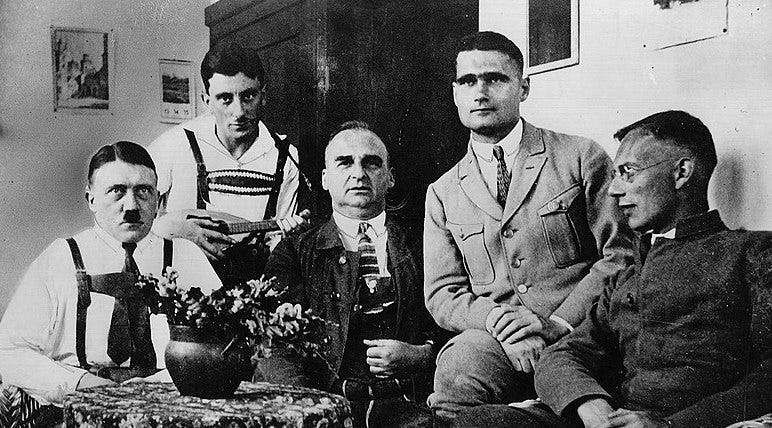
Hess had been Hitler’s closest companion since the early Munich days. He transcribed Mein Kampf as Hitler dictated it during their shared imprisonment at Landsberg after the 1923 Beer Hall Putsch. He was a true believer in the oldest sense — not an opportunist, not a technocrat, but a man who had built his identity entirely around Adolf Hitler.
By 1940, that position had eroded. Göring ran the Luftwaffe. Himmler ran the SS. Speer was rising. Hess found himself increasingly ceremonial — a title without a portfolio.
What he still had was an obsession: Britain and Germany should not be fighting each other. In his reading of geopolitics, both nations faced a common enemy in the Soviet Union. The war in the west was a tragic mistake. And he, Rudolf Hess, would fix it.
He had met the Duke of Hamilton briefly at the 1936 Berlin Olympics. In Hess’s mind, this constituted a diplomatic back channel. He made four practice flights over Germany to test his navigation. On the fifth, he kept going.
He bailed out over Scotland at roughly 6,000 feet, age 46, in the dark. By any measure of airmanship, the flight alone was extraordinary. What he found when he landed was not.
Three capitals, three reactions
Churchill, informed of Hess’s identity, reportedly said it was one of those cases where imagination is baffled by the facts — and then went to watch a Marx Brothers film. His government imprisoned Hess as a prisoner of war and said little publicly.
Hitler, informed the next morning, was furious and then calculating. He immediately declared Hess mentally ill — a lone madman acting without authorization. This was both convenient and plausible. Inconveniently, it raised the question of how a madman had been Deputy Führer.
Stalin concluded it was a secret British-German plot against him. He held this view for years. Historians have argued it deepened his catastrophic resistance to his own intelligence warnings about Barbarossa — which came six weeks later.
Keep in mind what the calendar said: May 10, 1941. The United States was neutral. Pearl Harbor was seven months away. Britain had been fighting Germany essentially alone for nearly a year. The Blitz had just wound down, 43,000 British civilians dead. Whether the Allies would survive was a genuinely open question.
Into this moment stepped a man with a briefcase full of self-authored peace terms and a broken ankle.
One year over Paris
There is a detail about the date that stops you cold.
May 10, 1941 was the first anniversary — to the day — of Germany’s invasion of France and the Low Countries. Operation Fall Gelb had launched on May 10, 1940. In twelve weeks it broke the French army, drove the British into the sea at Dunkirk, and delivered Paris to the Third Reich.
Hess had been party to all of it. He signed documents. He attended the meetings. He was present for the armistice terms that put France under occupation — that planted the swastika on the Eiffel Tower and turned the City of Light into a German garrison town.
On the first anniversary of that conquest, while Paris was twelve months into occupation, while Vichy was deepening its collaboration, while French men and women navigated the daily arithmetic of survival under enemy administration — on that exact day, the man who helped build that occupation flew away from it in a modified fighter plane, toward a Scottish farm field.
Whether the date was deliberate or coincidental, no one has ever established. It doesn’t matter. The symmetry holds.
The long afterward
The British tried Hess at Nuremberg in 1945. He was convicted on two of four counts — crimes against peace and conspiracy — and acquitted on war crimes and crimes against humanity, because he had been outside German decision-making since the night he flew away. He was sentenced to life.
He served it. All of it. At Spandau Prison in West Berlin, the Nazi hierarchy died or gained release one by one until Hess was the last prisoner remaining. The Soviets vetoed every clemency petition. For the final two decades of his sentence, the entire apparatus of Spandau — guards, staff, protocols, expense — was maintained for one increasingly frail old man who spent his days gardening and reading.
On August 17, 1987, Hess was found in a garden summerhouse, dead. He was 93. An electrical cord was looped around his neck. The official ruling was suicide.
His family disputed this immediately. Hess suffered from severe arthritis that had largely robbed him of grip strength. How, they asked, had he managed to loop and tighten a cord with hands that could barely hold a pen?
No satisfactory answer has ever been given. Within weeks of his death, Spandau was demolished — rubble carted away in trucks — to prevent it becoming a neo-Nazi shrine.
Hess had been a prisoner for 46 years. He holds the distinction, if it can be called that, of having served the longest imprisonment of any figure from the Second World War.
By the Numbers: The Flight of Rudolf Hess
Aircraft: Messerschmitt Bf 110D-3, modified with ventral drop tanks Distance: approximately 900 miles, Augsburg to Eaglesham Flight time: roughly four hours Navigation: dead reckoning, alone, no radio guidance Exit altitude: approximately 6,000 feet Injuries on landing: broken ankle Age of pilot: 46 Return fuel: none
Links:
British National Archives education service “Spotlight on …"
Will we ever know why?
A word from the author
Hess fascinates me for the same reason Eddie Grant does: both are men who decide, alone and without authorization, that they can personally change the outcome of a larger conflict through a single audacious act. The difference is that Eddie usually has better operational planning. In Treasure of Saint-Lazare, Eddie operates in the gray space between official sanction and personal judgment — the same space Hess stumbled into on May 10, 1941, with considerably less success. If that tension interests you, the novel is available on Amazon.
— John Pearce, Part-Time Parisian
Washington / Paris